OpenRouter is a unified API layer for LLMs. Developers point an OpenAI-compatible client at OpenRouter, choose a model slug, and can route across providers without rewriting application code.
The product is useful because the model market changes faster than most app code should. A team can compare ChatGPT, Claude, Gemini, DeepSeek, Qwen, Kimi, and smaller open models behind one billing account and one request schema. The June 13 AI Model Availability & Churn Tracker adds the important caveat: a router model listing is not the same as a provider-guaranteed production entitlement. After Anthropic suspended Fable 5 and Mythos 5 access, production apps should verify the exact provider route before relying on any high-risk or newly listed model.
Recent developments
- June 13, 2026: AiPedia added the AI Model Availability & Churn Tracker. For OpenRouter buyers, the key rule is simple: use model routing for optionality and fallbacks, but verify direct provider availability before making a model route part of a customer-facing SLA.
- May 27, 2026: OpenRouter announced a $113M CapitalG-led Series B and said usage reached 25 trillion tokens per week. The buyer signal is that model routing, governance, failover, and spend visibility are becoming enterprise AI infrastructure, not just developer convenience.
- May 13, 2026: Pricing structure verified. Three tiers: Free (25+ models, 50 requests/day), Pay-as-you-go (5.5% platform fee on 400+ models), Enterprise (custom volume pricing with SSO/SAML and regional routing). Zero Completion Insurance covers failed requests across all tiers.
- May 1, 2026: xAI moved Grok 4.3 into the API with OpenRouter access, making OpenRouter one of the fastest ways to benchmark Grok’s low-price reasoning profile against Claude, Gemini, OpenAI, Kimi, and Qwen without SDK rewrites.
- April 30, 2026: Poolside released Laguna XS.2 (33B MoE, Apache 2.0) for local agentic coding and Laguna M.1 (225B MoE) as a free-tier API. Both models are available through OpenRouter for testing, provider routing, and deployment alongside the other 400+ models.
- April 28, 2026: NVIDIA launched Nemotron 3 Nano Omni with OpenRouter listed as one of the access routes for the open multimodal agent model.
- April 28, 2026: Mistral 3 shipped with Large 3 and new Ministral models, giving OpenRouter users another open-model family to test against Llama, Qwen, DeepSeek, Gemma, and closed frontier models.
System Verdict
Pick OpenRouter if model choice is the bottleneck. It is especially strong for prototypes, indie apps, eval benches, and agent frameworks that need to try new models quickly.
Skip it for tightly governed enterprise deployments. Direct contracts with OpenAI, Anthropic, Google, or a cloud marketplace can be cleaner for security review, support escalation, and committed-use discounts.
The real value is not just aggregation. Provider routing, fallbacks, cost stats, app attribution, and OpenAI-compatible requests remove a lot of plumbing that small teams otherwise build themselves.
Key Facts
| Core product | Unified API and web chat for 400+ LLMs |
| API style | OpenAI-compatible chat completions |
| Providers | 60+ providers on Pay-as-you-go and Enterprise |
| Routing | Provider choice, provider fallback, price/latency sorting, regional routing |
| Tool calling | Available when the underlying model/provider supports it |
| Frontier routes | High-end OpenAI, Anthropic, Google, xAI, DeepSeek, Kimi, Qwen, Mistral, and Llama routes where provider availability and plan policy allow |
| Free tier | 25+ models, 50 requests/day |
| Pay-as-you-go | 5.5% platform fee on 400+ models and 60+ providers, prompt caching, activity logs, spend controls |
| Enterprise | Bulk discounts, SSO/SAML, policy controls, support SLA, custom limits |
| Reliability | Zero Completion Insurance covers failed requests |
| Best fit | Developer apps, agent tooling, model comparison |
Verified 2026-06-13 against openrouter.ai/pricing and the current model-availability tracker.
When to pick OpenRouter
- You need optionality. Model quality, latency, and price move weekly. OpenRouter makes switching less painful.
- You want fallback behavior. If a provider errors, routing can try alternatives instead of returning failure to the user.
- Your code already uses the OpenAI SDK. In many cases the migration is a base URL and model-name change.
- You are building an agent stack. Routing, tool-calling pass-through, and provider preferences are practical for agent workflows.
- You need visibility by model. Cost and generation metadata help teams compare more than benchmark vibes.
When to pick something else
- Direct vendor support matters. Use OpenAI, Anthropic, Google, or Mistral directly for contract-backed support.
- You need dedicated open-model infrastructure. Together AI, Fireworks AI, or Groq are better when the workload is mostly one model family.
- You need media-generation APIs. Fal.ai and Replicate cover image, video, and audio model hosting more deeply.
- Data controls are the sale. Ask for enterprise terms or use direct providers with explicit zero-retention commitments.
Pricing
| Tier | Cost | What you get |
|---|---|---|
| Free | $0 | 25+ models, 50 requests/day |
| Pay-as-you-go | 5.5% platform fee on top of per-model token rates | 400+ models, 60+ providers, prompt caching, activity logs, spend controls, failed/fallback attempts not billed |
| Enterprise | Custom (sales) | Bulk discounts, SSO/SAML, policy controls, support SLA, custom limits |
Per-model token pricing varies by provider route. Some models are free or promotional. The same app can run a free open model for background tasks and Opus 4.7 or GPT-5.5 for final answers.
That flexibility is the point and the risk. Without pinned budgets, provider preferences, and model choices, traffic can land on more expensive routes than expected. Prompt caching and the OpenAI-compatible app attribution header help track spend by surface.
Verified 2026-06-12 via openrouter.ai/pricing.
Failure Modes
- Provider variance. The same model name can behave differently by host, quantization, context length, or uptime.
- Governance complexity. A single gateway can touch many downstream providers. Security teams need to understand the route policy.
- Budget surprises. Model pages change as providers update pricing. Pin critical workflows and watch spend.
- Fallback quality drift. A fallback may preserve uptime while changing output quality. Use evals for critical flows.
- Not every feature is universal. Tool calling, structured outputs, multimodal input, and zero-retention options depend on model/provider support.
Methodology
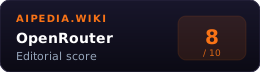
Last verified 2026-06-13 against OpenRouter’s pricing page, developer documentation, model surface, Anthropic’s Fable/Mythos access statement, and the May 26 funding/usage announcement. Scoring weighs developer utility, breadth of model access, pricing transparency, durability of the gateway role, and risk from provider dependence.
FAQ
Is OpenRouter just a proxy? No. The proxy is part of it, but routing, provider selection, fallbacks, rankings, cost stats, and app attribution are the product layer.
Can OpenRouter replace direct OpenAI or Anthropic APIs? For many prototypes and production apps, yes. For large regulated deployments, direct provider contracts may still be cleaner.
Does OpenRouter support tool calling? Yes when the selected underlying model and provider support tool/function calling.
Sources
Related
- Category: AI Infrastructure · AI Chatbots · AI Coding
- See also: ChatGPT · Claude · Gemini · Together AI · Fireworks AI · Groq