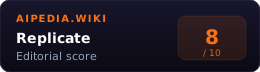
Replicate is a developer platform for running AI models through an API. It is best known for image and video generation models, but the catalog spans text, audio, vision, upscaling, segmentation, 3D, and custom deployments.
The product sits between a playground and a full cloud stack. Developers can run official models with stable APIs, call community models, or publish their own model containers without operating GPU infrastructure directly.
System Verdict
Pick Replicate when you want model variety and speed of integration. It is one of the easiest ways to add open-model image or video generation to an app.
Skip it when you already know the one model you need at large scale. At that point, dedicated hosting on Together AI, Fal.ai, Modal, or your own cloud GPUs may be more predictable.
Replicate’s biggest advantage is discovery-to-API workflow. Find a model, test it in the browser, call it from code, then decide later whether to move to custom infra.
Key Facts
| Core product | Hosted AI model API |
| Model types | Image, video, audio, text, vision, 3D, utility models |
| Official models | Always-on, maintained, stable API, predictable pricing |
| Community models | Broad catalog, variable quality and maintenance |
| Custom models | Publish and run your own containerized models |
| Pricing | Usage-based by official model metric or hardware runtime |
| Private models | Usually billed while dedicated hardware is online, including idle time |
| Best fit | Developer prototypes and product integrations |
When to pick Replicate
- You want to test a model quickly. Browser playground plus API examples make evaluation fast.
- Your app needs image or video generation. The catalog is deep and changes quickly.
- You prefer official model stability. Official models avoid version surprises and cold-boot pain.
- You need custom model deployment without DevOps. Package the model and let Replicate handle serving.
- You are comparing alternatives. Replicate is useful as a neutral test bench before committing to self-hosting.
When to pick something else
- Fastest media inference: Fal.ai is usually the speed-first pick for production image/video APIs.
- Open LLM infrastructure: Together AI or Fireworks AI.
- Serverless GPU apps beyond model calls: Modal gives more control over Python apps, jobs, and web endpoints.
- Creator workflows: Midjourney, Runway, Krea, or Leonardo.
Pricing
Replicate uses two main pricing patterns. Some public models are billed by input and output, such as images, video seconds, or tokens. Many public and community models are billed by the hardware used and the time they take to run.
Private models are different. Most private models run on dedicated hardware, so teams can pay for setup time, idle time, and active processing time while the deployment is online. Fast-booting fine-tunes are an exception when labeled that way. This is fair for experimentation but needs monitoring in production. Slow models, high-resolution outputs, idle deployments, and retries can move the bill faster than a flat SaaS plan.
As verified on 2026-06-12, Replicate’s hardware rates run from CPU at $0.09/hr (small) or $0.36/hr (standard), through T4 at $0.81/hr, L40S at $3.51/hr (2x at $7.02), A100 80GB at $5.04/hr (2x at $10.08), and H100 at $5.49/hr (2x at $10.98). 4x and 8x GPU configurations require committed-spend contracts. Output-priced examples include FLUX 1.1 Pro at $0.04 per image, Wan 2.1 i2v at $0.09 per second of 480p output video or $0.25 per second of 720p output video, Claude 3.7 Sonnet at $3 per million input tokens plus $0.015 per thousand output tokens, and DeepSeek R1 at $3.75 per million input tokens plus $0.01 per thousand output tokens. Enterprise and volume-discount conversations can add higher GPU limits, performance SLAs, priority support, onboarding help, and custom-model optimization.
Evaluation checklist
Before using Replicate in production:
- Prefer official models when API stability and predictable pricing matter.
- Check the specific model page for cost estimates before building a feature around it.
- Measure cold starts, runtime, queueing, and retries on realistic prompts.
- Decide whether the model needs private deployment or can run as a public model call.
- Track high-resolution media, long video outputs, and failed runs separately.
- Compare custom deployments against Modal, Fal.ai, Together AI, Fireworks AI, or direct cloud GPUs once volume is predictable.
Buyer fit
Replicate is strongest for teams that are still exploring model choice. It lets developers compare image, video, audio, vision, and utility models quickly, then turn the winning model into an API call without building infrastructure first.
providers or self-managed GPU infrastructure may offer better latency, controls, or unit economics. Replicate is often the right first production path, but not always the cheapest final path.
Failure Modes
- Community model drift. Non-official models may change, break, or become stale.
- Cold starts. Some workloads still pay a latency penalty when capacity is not warm.
- Per-run cost opacity. Hardware-runtime pricing can be harder to estimate than per-output pricing.
- Not an end-user product. Replicate is an API and model catalog, not a polished creative suite.
- Migration work later. The easiest prototype path may not be the cheapest long-term deployment.
- Idle private deployments cost money. Dedicated private hardware changes the economics compared with public per-run model calls.
Methodology
Last verified 2026-06-12 against Replicate’s official model and pricing documentation. Scoring emphasizes model breadth, developer experience, production stability, and cost predictability.
FAQ
What are Replicate official models? Official models are maintained by Replicate, kept warm, exposed through stable APIs, and priced predictably.
Can I run my own model on Replicate? Yes. Replicate supports custom model deployment through packaged model containers.
Is Replicate better than Fal.ai? Replicate is broader as a model catalog. Fal.ai is stronger when speed and production media inference are the top priorities.
Related
- Category: AI Infrastructure · AI Image · AI Video
- See also: Fal.ai · Flux · Runway · Together AI · Modal