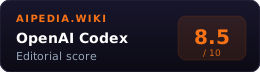
OpenAI’s agentic coding product. A coding agent that works either async in the cloud (fire a task, come back to a PR) or locally via the Codex Desktop app, CLI, and IDE extensions. Backed by GPT-5.5 for harder work and GPT-5.3-Codex-Spark for faster routine coding.
Bundled with every paid ChatGPT tier. Pro tiers get 5x to 20x the Codex usage of Plus. The April 16, 2026 super-app update turned Codex Desktop into the most capable OpenAI product surface to date: Computer Use, persistent Memory, gpt-image-2 for visuals, an in-app browser, 90+ plugins, and multi-agent workflows running in parallel. The June 11 Ona acquisition agreement makes persistent, customer-controlled cloud execution the next Codex enterprise control to watch.
Recent developments (March-June 2026)
- June 11, 2026: OpenAI agreed to acquire Ona to bring secure, customer-controlled cloud execution and orchestration into Codex. OpenAI says Codex now has more than 5 million weekly users and that Ona helps agents keep working across devices, sessions, and long-running enterprise workflows. Treat the deal as a roadmap signal until it closes and the integrated controls are visible in customer accounts.
- June 11, 2026: OpenAI added rate-limit reset banking and referrals to Codex. Plus and Pro users can bank a reset, while Business workspaces can use shared credit rewards through a separate referral program.
- May 22, 2026: OpenAI said Codex was named a Leader in Gartner’s enterprise coding-agent report. The procurement signal is that Codex is being evaluated around governance, sandboxing, approval gates, RBAC, policy controls, and deployment surfaces, not just code-generation quality.
- May 21, 2026: OpenAI added AppShots, Goal Mode, locked computer use, and browser improvements to Codex. Ramp’s Codex case study adds a real engineering-team proof point for using Codex as a code-review and internal-agent layer.
- May 20, 2026: OpenAI IPO reporting, Anthropic profit forecasts, and SpaceX compute costs made frontier AI economics more visible. For Codex buyers, the practical takeaway is to track rate limits, capacity, and model-routing changes alongside raw coding quality.
- May 19, 2026: OpenAI added C2PA conformance, SynthID watermarking, and a public verification-tool preview for images generated through ChatGPT, Codex, and the API. This matters for Codex because generated images and visual assets now need provenance checks, not just model-quality review.
- May 18, 2026: OpenAI and Dell announced a Codex partnership for hybrid and on-premises enterprise environments. The buyer signal is governed data proximity: Codex is being positioned closer to enterprise repositories, business systems, and internal context rather than only as a cloud coding assistant.
- May 18, 2026: Musk lost his OpenAI lawsuit. No Codex feature changed, but one legal overhang around OpenAI’s structure is smaller while enterprise buyers should still review vendor concentration, model availability, and data-control terms.
- May 16, 2026: OpenAI put Greg Brockman over product strategy as ChatGPT and Codex converge. ChatGPT, Codex, and the developer API are being folded into one core product team, reinforcing Codex as a central OpenAI agent surface rather than a standalone coding add-on.
- May 14, 2026: OpenAI put Codex inside the ChatGPT mobile app. The preview lets users monitor active Codex work, review terminal output and diffs, approve commands, change models, and start new tasks from iOS or Android while files, credentials, and repo context stay on a connected machine or remote environment. Remote SSH and Hooks are now generally available as part of the same Codex push.
- May 13, 2026: OpenAI detailed Codex’s Windows sandbox, closing the macOS / Linux parity gap with a design based on restricted tokens, synthetic SIDs, ACL setup, dedicated sandbox users, firewall rules, and a command-runner binary. AppContainer was evaluated and rejected as too narrow for open-ended developer workflows. Enterprise Windows fleet evaluations that were blocked on isolation can re-open with a concrete design to review.
- May 11, 2026: OpenAI launched Daybreak with Codex Security as the anchor product. Daybreak wraps Codex Security in three model tiers (GPT-5.5, Trusted Access, GPT-5.5-Cyber) and onboards 22 launch partners across Cloudflare, Cisco, CrowdStrike, Palo Alto Networks, Snyk, Semgrep, Socket, and more. Codex Security is now the operational center of OpenAI’s defensive-cyber play and the most consequential Codex announcement since the April 16 super-app update.
- May 11, 2026: OpenAI consolidated its commercial operations under an OpenAI Deployment Company. The restructure cleans the path for enterprise distribution of Codex, ChatGPT, and Daybreak across hyperscalers and government customers.
- May 11, 2026: OpenAI opened a GPT-5.5-Cyber EU preview, bringing the cyber-permissive model to European defenders inside Trusted Access. Relevant to Codex Security customers operating under EU data-residency requirements.
- May 7, 2026: OpenAI added Codex for Chrome, letting the Codex desktop app work directly across signed-in Chrome tabs on macOS and Windows. Treat it as a major workflow unlock and a permission-scope decision: the value is real browser context; the risk is letting an agent operate inside authenticated web apps.
- May 7, 2026: OpenAI shipped Realtime 2 with two new voice models. The lower-latency bidirectional stack tightens voice-driven Codex workflows for hands-free coding sessions and dictation in Codex Desktop.
- May 2, 2026: Codex Desktop added Pets, Hatch custom pet generation, cross-agent config imports, and a dictation dictionary. The playful overlay is less important than the config portability: Codex can now import conventions from tools such as Claude Code instead of forcing users to rewrite setup context.
- May 1, 2026: The MCP STDIO command-execution flaw put agent connectors back under security review. Codex Desktop’s plugin/MCP layer should be treated as privileged tool access, not as harmless extension metadata.
- May 1, 2026: The Pentagon expanded classified-network AI access to eight major vendors, including OpenAI. This is a government deployment story rather than a public Codex feature, but it reinforces why account security, network boundaries, and audit controls matter for agentic OpenAI products.
- April 30, 2026: OpenAI added Advanced Account Security for ChatGPT and Codex. Hardware-key and passkey protection now matter more because Codex accounts can touch repos, terminals, plugins, and connected development workflows.
- April 30, 2026: OpenAI began rolling GPT-5.5 Cyber to critical defenders through Trusted Access. The relevant Codex angle is controlled access to cyber-permissive capabilities, not broad public availability.
- April 30, 2026: A coding-agent security roundup warned that attackers keep targeting credentials, not model weights. Codex evaluations should include sandbox isolation, token scopes, account security, and audit trails alongside model quality.
- April 30, 2026: OpenAI and Microsoft gut exclusivity, freeing OpenAI to serve products across AWS and Google Cloud. Codex now has a clearer path to non-Azure enterprise distribution, but practical availability still depends on future product rollouts.
- April 30, 2026: OpenAI’s DevDay 2026 is set for September 29. Codex roadmap and product direction will likely be a centerpiece of the event.
- April 29, 2026: Agent skill libraries are becoming the new coding-agent workflow layer. Codex benefits from the same shift toward reusable local skills, templates, and MCP-aware workflow modules instead of one-off prompts.
- April 28, 2026: Codex comes to Amazon Bedrock as part of the expanded OpenAI/AWS partnership. Limited preview starts with Codex CLI, the desktop app, and the VS Code extension configured to use Bedrock as the provider.
- April 27, 2026: OpenAI and Microsoft made their model partnership non-exclusive. Codex remains part of the OpenAI product stack, but enterprise deployment optionality around OpenAI products now matters more than Azure exclusivity alone.
- April 27, 2026: Musk v. OpenAI trial opens with fraud claims dismissed. No immediate Codex feature changes, but governance disclosures and remedies could still affect OpenAI’s operating model.
- April 27, 2026: OpenAI publishes new principles for the next AGI phase. Developers should watch how those principles translate into model access, safety gates, enterprise controls, and Codex release notes.
- April 25, 2026: AI News Desk, April 25 grouped GPT-5.5 API access, Copilot distribution, Project Deal, and Google-Anthropic financing as the weekend signals around Codex’s market.
- April 24, 2026: AI Industry Roundup, April 24 tracked GPT-5.5’s spread into Copilot; GitHub Copilot adds GPT-5.5 is the direct competing-coding-surface rollout.
- April 23, 2026: GPT-5.5 rolls out to ChatGPT and Codex. OpenAI positions it for longer-running coding, research, data analysis, documents, spreadsheets, and tool-use tasks.
- April 23, 2026: AI Industry Roundup, April 23 covered GPT-5.5, Cloud Next, Grok Voice, Grok outages, and EU AI funding; GPT-5.5 system card and bio bounty added safety context for Codex’s backing model.
- April 22, 2026: Responses API adds WebSockets. Relevant to Codex-style agent loops because lower-latency bidirectional sessions make browser/IDE agent workflows feel less stop-start.
- April 23, 2026: Google discloses 75% of internal new code is AI-generated. Signals agentic-coding adoption inside hyperscalers has crossed the “production default” threshold. Codex sits in the same category as Gemini Code Assist for this cohort.
- April 23, 2026: Gemini Enterprise Agent Platform launches. Google now ships a full enterprise agent stack (Studio, Registry, Identity, Gateway, Observability) competing with Codex for governed-agent use cases. Codex counter is the April 16 super-app update’s plugin ecosystem and Computer Use.
- April 21, 2026: Moonshot Kimi K2.6 ships with Agent Swarm mode, posting SWE-bench Pro 58.6 as the strongest open-weights baseline. Raises the ceiling for self-hosted alternatives to Codex.
- April 16, 2026: Codex Desktop ships as OpenAI “super app”. Computer Use, Memory, gpt-image-2, in-app browser, 90+ plugins, multi-agent workflows. macOS first; Windows and EU/UK rolling out.
- April 16, 2026: Systemic MCP vulnerability exposes 200k servers. Codex Desktop’s 90+ plugins + MCP tool access all inherit the exposure. Audit third-party servers; prefer first-party.
- April 16, 2026: Agents SDK ships native sandbox execution, model-native harness, configurable memory, snapshotting. Python first, TypeScript coming.
- April 9, 2026: $100/mo Pro tier launched. Between ChatGPT Plus ($20) and the former $200 Pro (now Pro 20x). 5x Codex vs Plus; 10x promo through May 31.
- April 2, 2026: API-aligned billing. Switched from per-message to per-token credit consumption (credits per MTok input, cached input, output).
System Verdict
Pick Codex if you want an async coding agent that runs in the background while you do other work. Codex’s “fire a task, come back to a pull request” model is the strongest pattern in the category for routine features, test generation, boilerplate, and documentation. The April 16 super-app update makes Codex Desktop the most capable all-in-one developer surface from OpenAI, the May 7 Codex Chrome extension extends that surface into signed-in browser workflows, and the May 11 Daybreak launch puts Codex Security at the center of OpenAI’s defensive-cyber product. Best for users already paying for ChatGPT Plus or higher.
Skip it if you need a Linux desktop GUI today, primary in-IDE coding, or the tightest terminal agent. Cursor owns daily-driver IDE coding with real-time autocomplete and in-editor chat. Claude Code owns terminal-native autonomous runs and the 1M context window for codebase-scale work. Devin owns fully-autonomous enterprise agent-first workflows. Codex is strongest as a hybrid: async cloud agent + capable desktop companion.
Who pays which tier: Plus $20/mo for most individuals doing occasional Codex tasks, Pro $100/mo for engineers running Codex weekly (5x usage, matches Claude Max 5x pricing), Pro 20x $200/mo for sustained agentic coding workloads. Business $25/user for teams. Codex-only seats are available with pay-as-you-go token billing.
Key Facts
| Default model | GPT-5.5 for harder work; GPT-5.3-Codex-Spark for faster routine coding on supported surfaces |
| Enterprise signal | OpenAI says Codex has 5M+ weekly users and was named a Leader in Gartner’s 2026 Enterprise AI Coding Agents Magic Quadrant |
| Persistent execution signal | OpenAI’s June 11 Ona acquisition agreement targets customer-controlled cloud environments for long-running Codex agents, scoped credentials, activity logging, and reviewable production workflows |
| Fast model | GPT-5.3-Codex-Spark (research preview, faster daily-coding) |
| Primary surfaces | Codex Desktop (macOS, Windows rolling) · ChatGPT web · Codex CLI · IDE extensions |
| Async cloud execution | Yes. Sandboxed VM spins up per task; Codex returns a diff or PR |
| Computer Use | Yes (new April 16, macOS first). Codex operates desktop apps with a virtual cursor |
| Memory | Persistent across sessions (new April 16). Remembers preferences, corrections, setup context |
| Image generation | gpt-image-2 bundled in Codex Desktop (new April 16) |
| In-app browser | Yes (new April 16). Research, form-fill, scrape without leaving the app |
| Plugins | 90+ (new April 16). Combines skills, app integrations, MCP servers |
| Chrome extension | Yes (new May 7, 2026). Codex Desktop operates across signed-in Chrome tabs on macOS and Windows |
| Codex Security | Anchor product of OpenAI’s May 11 Daybreak launch. 22 partners including Cloudflare, Cisco, CrowdStrike, Palo Alto Networks, Snyk, Semgrep, Socket |
| Cyber model tiers | GPT-5.5 · Trusted Access · GPT-5.5-Cyber (EU preview opened May 11, 2026) |
| Multi-agent | Yes. Run multiple Codex agents concurrently across different tasks or modules |
| Voice | Realtime 2 voice models (new May 7, 2026) tighten dictation and hands-free Codex sessions |
| Billing | Credits per MTok input / cached input / output (since April 2, 2026) |
| Platform support | macOS (primary) · Windows rolling out · EU/UK rolling out · Linux via CLI |
| Cloud distribution | OpenAI Deployment Company (formed May 11, 2026) consolidates enterprise distribution; Amazon Bedrock preview live since April 28, 2026 |
Current Codex product, pricing, and Ona acquisition facts verified 2026-06-15 against OpenAI’s Codex page, Codex pricing docs, OpenAI’s Ona announcement, and Ona’s own announcement. Earlier event links remain sourced through their linked AiPedia coverage.
What it actually is
Three related surfaces united by the same underlying agent:
1. Async cloud agent (the original Codex). From inside ChatGPT, you describe a task (“add a new settings page to this repo, tests included”). Codex spins up a sandboxed VM with your codebase cloned in, works through the task independently over minutes or hours, and returns a diff or pull request. You continue with other work meanwhile.
2. Codex Desktop (the April 16 super-app). A standalone macOS app (Windows rolling out) that runs multiple Codex agents in parallel, uses Computer Use to operate applications directly, holds persistent Memory across sessions, generates images with gpt-image-2, browses the web in-app, and orchestrates 90+ plugins including first-party app integrations and third-party MCP servers.
3. Codex CLI + IDE extensions. Local-first developers use Codex as a terminal CLI (similar shape to Claude Code) or via IDE extensions in VS Code, JetBrains, and others. IDE extensions hit the same GPT-5.5 and Codex-Spark model family that backs the cloud and desktop surfaces.
4. Codex for Chrome (May 7, 2026). A browser extension that lets Codex Desktop inspect, test, and operate across signed-in Chrome tabs on macOS and Windows. Real browser context, with the corresponding permission-scope trade-off because the agent runs inside authenticated web apps.
5. Codex Security (May 11, 2026). Anchor product of OpenAI’s Daybreak defensive-cyber launch. Wraps GPT-5.5, Trusted Access, and GPT-5.5-Cyber model tiers with a Codex Security plugin that handles threat modeling, vulnerability discovery, validation, attack-path analysis, and verified fixes. Twenty-two launch partners including Cloudflare, Cisco, CrowdStrike, Palo Alto Networks, Snyk, Semgrep, and Socket. GPT-5.5-Cyber is now in EU preview through Trusted Access.
6. Ona and persistent enterprise execution (pending close). OpenAI’s June 11 Ona acquisition agreement is meant to add secure, customer-controlled cloud environments where long-running Codex agents can keep state, access scoped tools, log activity, and continue work across devices. Do not treat this as a shipped customer feature until the transaction closes and OpenAI exposes the integrated controls.
The real moat is the cross-surface consistency. A task started in the desktop app can hand off to the cloud agent. Memory carries across sessions and surfaces. Plugins work everywhere. OpenAI is treating Codex as the front end of a developer-focused super app rather than a single product.
When to pick OpenAI Codex
- You already pay for ChatGPT Plus, Pro, or Business. Codex is included. Claude Code needs a separate Claude subscription; Cursor needs a separate Cursor Pro.
- You want async background work. Fire tasks, keep coding, come back to PRs. This is Codex’s strongest pattern.
- You run multiple parallel tasks. Codex’s multi-agent workflows parallelize across different modules, different repos, or different kinds of work.
- You need Computer Use. Codex Desktop operates apps directly with a virtual cursor. Useful when an MCP server or API doesn’t exist for your target app.
- You want plugin-ecosystem depth. 90+ plugins covering Figma, Linear, GitHub, Notion, Slack, Jira, and more. Fewer setup hops than assembling your own MCP stack.
- You like Memory across sessions. Cross-session context survives restarts so you don’t re-explain your setup.
When to pick something else
- Daily-driver IDE coding: Cursor. Tighter in-editor autocomplete, Composer for multi-file edits, and Cursor 3’s Agents Window for parallel agent orchestration. Works on Linux, macOS, Windows.
- Terminal-native autonomous runs: Claude Code. Strongest CLI coding agent; 1M context on Opus 4.8; Ultraplan cloud environments; no desktop-app requirement.
- Fully-autonomous enterprise agent: Devin by Cognition AI. $500/mo Teams. Agent-first from the ground up, runs end-to-end without human review.
- Open-source terminal agent: Aider. Free, self-hosted, works with any model including local Ollama.
- IDE plugin inside existing VS Code setup: GitHub Copilot. Deepest Microsoft ecosystem integration.
- Hosted full-app builder: Replit Agent. Runs the full app lifecycle on Replit infrastructure.
Pricing
Codex is bundled with every paid ChatGPT tier. No standalone Codex subscription. Usage scales with tier.
| ChatGPT tier | Monthly | Codex usage vs Plus |
|---|---|---|
| Free | $0 | Limited Codex (rate-limited) |
| Go | $8 | Basic Codex |
| Plus | $20/mo | 1x (baseline) |
| Pro | $100/mo | 5x (10x promo through May 31, 2026) |
| Pro 20x | $200/mo | 20x |
| Business | $25/user/mo | Per-seat Codex + admin controls |
| Enterprise | Custom | Custom usage + SSO + compliance |
API-aligned billing (since April 2, 2026): Credits are the purchase unit. Consumption is measured in input tokens, cached input tokens, and output tokens, not per-message. Teams on pay-as-you-go get transparent cost-per-task tracking.
Prices verified 2026-06-12 via OpenAI Codex pricing and the Codex rate card.
Against the alternatives
| OpenAI Codex | Claude Code | Cursor | Devin | |
|---|---|---|---|---|
| Primary surface | Desktop app + cloud + CLI | Terminal CLI | VS Code fork IDE | Web app |
| Async cloud execution | Yes (sandboxed VM) | Ultraplan cloud environments | Cloud sandboxes + parallel agents | Yes, cloud-native by default |
| Backing model(s) | GPT-5.5 + GPT-5.3-Codex-Spark | Claude Opus 4.8 + Sonnet 4.6 | User-selectable (Claude, GPT, Gemini, Grok, Composer 2.5) | Proprietary Cognition models |
| Computer Use | Yes (April 16, macOS first) | Research preview in Claude Code | No native computer use | Yes, agent-native |
| Memory | Yes (April 16, persistent cross-session) | Projects + session scope | Via .cursorrules + rules | Agent-native memory |
| Image generation | gpt-image-2 bundled | None native | None native | None native |
| Plugins / ecosystem | 90+ (April 16) | MCP registry + Anthropic Skills | Extensions + custom commands | Built-in toolset |
| Platform support | macOS now; Windows + EU/UK rolling; Linux via CLI | macOS, Windows, Linux | macOS, Windows, Linux | Web (cross-platform) |
| Pricing model | Bundled with ChatGPT Plus+ | Bundled with Claude Pro+ | $20/mo Cursor Pro + API | $500/mo Teams |
| Best for | Async background work + OpenAI ecosystem | Long-context terminal agent | Primary daily-driver IDE | Fully autonomous tasks |
Recent changes
- June 11, 2026: OpenAI agreed to acquire Ona for secure, customer-controlled cloud execution and orchestration inside Codex. Buyer check: where the agent runs, how credentials are scoped, what gets logged, and which actions require review before merge, deploy, or data access.
- June 11, 2026: OpenAI added rate-limit reset banking and referrals to Codex, making usage limits less arbitrary for Plus, Pro, and eligible Business users.
- May 19, 2026: OpenAI added C2PA conformance, SynthID watermarking, and a public verification-tool preview for images generated through ChatGPT, Codex, and the API.
- May 18, 2026: OpenAI and Dell announced a Codex partnership for hybrid and on-premises enterprise environments.
- May 18, 2026: Musk lost his OpenAI lawsuit, reducing one governance overhang for ChatGPT and Codex buyers.
- May 16, 2026: OpenAI put Greg Brockman over product strategy as ChatGPT and Codex converge, making the ChatGPT-Codex unification an official product-organization priority.
- May 11, 2026: OpenAI launched Daybreak, wrapping Codex Security with GPT-5.5 / Trusted Access / GPT-5.5-Cyber tiers and onboarding 22 partners (Cloudflare, Cisco, CrowdStrike, Palo Alto Networks, Snyk, Semgrep, Socket, and more). Codex Security is now the operational center of OpenAI’s defensive-cyber play.
- May 11, 2026: OpenAI formed an OpenAI Deployment Company to consolidate enterprise commercial operations for ChatGPT, Codex, and Daybreak. Cleans up multi-cloud Codex distribution after the April 30 Microsoft non-exclusivity restructure.
- May 11, 2026: GPT-5.5-Cyber EU preview opened through Trusted Access for Cyber. Codex Security customers operating in the EU now have a path to the cyber-permissive model under EU compliance posture.
- May 7, 2026: OpenAI added Codex for Chrome so Codex can inspect, test, and operate across signed-in Chrome tabs while keeping control in the desktop app.
- May 7, 2026: OpenAI shipped Realtime 2 with two new voice models, reducing latency for Codex dictation and hands-free sessions in Codex Desktop.
- May 7, 2026: OpenAI put GPT-5.5-Cyber into limited preview through Trusted Access for Cyber. The same announcement also introduced Codex Security for open source maintainers and a Codex Security plugin for moving from threat modeling to discovery, validation, attack-path analysis, and verified fixes.
- May 3, 2026: Codex Desktop added Pets, Hatch, and config imports, a small but visible sign that OpenAI is turning Codex into a persistent desktop workbench.
- April 28, 2026: Codex available on Amazon Bedrock via limited preview, with Codex CLI, the desktop app, and the VS Code extension all configurable to use Bedrock as the provider.
Failure modes
- macOS-first desktop app. Windows + EU/UK rolling out but not yet universal. Linux developers use the CLI or wait.
- Async tasks can fail silently. Cloud-sandboxed VMs sometimes error without a clear message. Check task status rather than assuming success.
- 90+ plugin surface = larger attack surface. The April 16 MCP vulnerability and the May 1 MCP STDIO command-execution disclosure affect every Codex MCP server. Audit third-party plugins and sandbox STDIO tools before trusting them with shell access.
- Pricing complexity. Free / Go / Plus / Pro / Pro 20x / Business / Enterprise is a lot of tiers. Users often pay for the wrong one. Baseline recommendation: Plus for individuals, Pro for active coders, Pro 20x only for sustained daily use.
- Ona is not integrated until the deal closes. The acquisition is subject to closing conditions and regulatory approvals. Evaluate current Codex controls as they exist in your account, and treat customer-controlled persistent execution as a roadmap signal until OpenAI ships it.
- Codex quality lags Claude Code on strict SWE-bench. Claude Opus 4.8 leads SWE-bench Verified; Codex is close behind at ~80%. Codex wins on Terminal-Bench 2.0 at 77.3% for autonomous terminal ops.
- Computer Use is early. Works for simple app operations; fragile for complex UI automation. Test your workflow before relying on it.
- Memory is not end-to-end encrypted by default. Enterprise tiers add stronger guarantees; consumer tiers store persistent context on OpenAI’s infrastructure subject to their data retention policies.
Methodology
This page was produced by the aipedia.wiki editorial pipeline, an automated system that ingests vendor documentation and multi-source news coverage, verifies facts against primary sources, and generates the editorial analysis you are reading. No individual human wrote this review. Scoring follows the four-dimension rubric at /about/scoring/ (Utility, Value, Moat, Longevity, unweighted average). Current Codex product, pricing, and Ona acquisition facts were verified on 2026-06-15 against OpenAI’s Codex page, Codex pricing docs, OpenAI’s Ona announcement, and Ona’s own announcement, alongside the June 11 Ona acquisition coverage and Codex rate-limit banking coverage. Earlier recent-development links remain sourced through their linked AiPedia coverage.
FAQ
Is Codex a separate subscription? No. Codex is bundled with every paid ChatGPT tier: Plus ($20/mo), Pro ($100/mo), Pro 20x ($200/mo), Business ($25/user/mo), and Enterprise.
What’s the difference between Codex, ChatGPT, and Codex Desktop? ChatGPT is the general-purpose assistant. Codex is the coding agent inside ChatGPT and in standalone surfaces. Codex Desktop is the macOS app that runs Codex agents + Computer Use + 90+ plugins. Same underlying product family.
How does Codex compare to Claude Code? Both are agentic coding products. Codex works async in the cloud and via desktop app; Claude Code runs terminal-native on your local machine with the 1M Opus 4.8 context window. Claude Code is tighter for long-context refactors; Codex is stronger for async background work and plugin-driven workflows.
How does Codex compare to Cursor? Cursor is an IDE (VS Code fork) optimized for daily in-editor coding with real-time autocomplete, Composer, and the Agents Window for parallel agents. Codex is primarily async cloud + desktop app. Many developers use both: Cursor as primary IDE, Codex for fire-and-forget tasks.
Can I run Codex on Linux? Codex Desktop is macOS-first with Windows rolling out. Linux users access Codex via the Codex CLI or ChatGPT web. A native Linux desktop app has not been announced.
What’s GPT-5.3-Codex-Spark? A faster Codex-optimized model in research preview as of April 2026. Designed for day-to-day coding with lower latency than full GPT-5.5 reasoning runs. Available on Pro and Pro 20x tiers.
Does Codex support MCP? Yes. Codex Desktop’s plugin system uses MCP under the hood for tool access. Be aware of the April 16 systemic MCP vulnerability before installing third-party MCP servers.
What is Memory? Persistent context across Codex sessions. Remembers your preferences, corrections, and project setup so you don’t re-explain environment details each time. Launched April 16, 2026 on the ChatGPT-signed-in Codex Desktop.
Can Codex operate other apps? Yes via Computer Use (April 16, macOS first). Codex sees the screen, controls a virtual cursor, clicks, and types. Useful when MCP plugins or APIs don’t exist for your target app.
Is there a team tier? Yes. ChatGPT Business at $25/user/mo. Plus Codex-only seats with pay-as-you-go token billing for teams that want Codex without full ChatGPT per-user costs.
Sources
- OpenAI: Codex product page
- OpenAI: Codex pricing
- OpenAI: Codex rate card
- OpenAI: Codex flexible pricing for teams
- OpenAI: OpenAI to acquire Ona
- Ona: Ona is joining OpenAI
- Codex for Chrome coverage
- Codex Desktop Pets and config-import update
- Codex Desktop super-app coverage
- Builder.io: Codex vs Claude Code comparison
- The New Stack: Cursor + Claude Code + Codex merging into one AI coding stack
- DataCamp: Codex vs Claude Code
- Apidog: Cursor vs OpenAI Codex
Related
- Category: AI Coding
- Parent product: ChatGPT (Codex ships inside every paid ChatGPT tier)
- Direct competitors: Claude Code · Cursor · Devin · Aider · GitHub Copilot · Replit Agent · Windsurf
- News: Codex for Chrome · Codex Desktop super-app · Pro tier launch