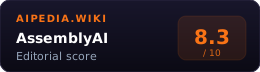
AssemblyAI is a Voice AI platform for developers. It provides speech-to-text, streaming transcription, speech understanding, LLM Gateway, guardrails, and a Voice Agent API for teams building speech products.
The main decision is not AssemblyAI versus a meeting note app. It is AssemblyAI versus Deepgram, Whisper, Google Speech-to-Text, Azure AI Speech, Amazon Transcribe, and other API providers.
System Verdict
Pick AssemblyAI when transcription quality and speech understanding are product features. It is strong for developers who need diarization, formatting, multilingual transcription, and higher-level audio intelligence.
Skip it for end-user productivity. If the job is “join my meetings and summarize them,” use Fathom, Fireflies, Otter.ai, or Read AI.
AssemblyAI’s edge is the productized speech intelligence layer around transcription, not just raw ASR.
What Changed Since The Last Refresh
The June 18 refresh found that AssemblyAI changed more in product shape than in headline STT prices.
- Universal 3.5 Pro is now documented as a preview pre-recorded model with 18-language support.
- Its main test reasons are stronger accented-English handling, code switching, contextual prompting, and Universal-2 fallback for broader language coverage.
- reasoning, TTS, tool calling, logs, and observability at $4.50/hr.
- The model map is sharper: Universal-3 Pro remains the high-accuracy pre-recorded route, Universal-2 is the lower-cost and 99-language fallback route, Universal-3 Pro Streaming is the premium real-time route, and Universal-Streaming is the lower-cost real-time route.
- LLM Gateway and Speech Understanding now need regional scrutiny because AssemblyAI documents US and EU endpoints, 25+ model access, fallbacks, post-processing, transcript injection, streaming-turn LLM calls, and paid rate limits.
- Billing risk is clearer than the older page implied: pre-recorded files bill by processed audio seconds, streaming bills by open WebSocket session duration, unclosed streams can bill until the 3-hour auto-close, and multichannel files bill per channel.
- The docs now explicitly support AI coding-agent workflows through an integration prompt, docs MCP server, and AssemblyAI skill, which matters for teams letting Codex, Claude Code, Cursor, Copilot, or Devin scaffold integrations.
Key Facts
| Core product | Voice AI APIs |
| Speech-to-text | Pre-recorded file transcription |
| Streaming | Real-time WebSocket transcription |
| Speech understanding | Summaries, chapters, sentiment, PII and more |
| Models | Universal speech-to-text model family |
| Preview model | Universal 3.5 Pro preview for pre-recorded STT |
| Free tier | Up to 185 hours pre-recorded and 333 hours streaming, no card required |
| Voice Agent API | Pay-as-you-go voice-agent stack priced separately from STT |
| LLM Gateway | US and EU endpoints with model routing, fallbacks, and speech workflows |
| Best fit | Products that need transcription and audio intelligence |
When to pick AssemblyAI
- You need strong transcription quality. Test against your own audio before committing.
- You need more than a transcript. Speaker labels, formatting, summaries, chapters, and content signals matter.
- You are building real-time voice experiences. Streaming transcription is a core product.
- You want one voice AI API surface. STT, speech understanding, LLM Gateway, and guardrails are under one vendor.
- You need developer documentation and examples. The platform is built for API integration.
- You want a voice-agent path. AssemblyAI now promotes a Voice Agent API as the fastest path to a working voice agent.
- You need AI-agent-friendly docs. The docs now publish coding-agent instructions, MCP setup, and skill guidance for integration work.
When to pick something else
- Voice agents with bundled TTS: Deepgram may be cleaner for full live voice stacks.
- Meeting assistant: Fathom, Fireflies, Read AI, Tactiq.
- Editing: Descript.
- Local open transcription: Whisper.
Pricing
AssemblyAI now ships a generous free tier (up to 185 hours of pre-recorded transcription and 333 hours of streaming with no credit card) in place of the older $50 credit grant shown on stale third-party summaries. Paid speech-to-text pricing varies by model, with Universal-2 and Universal-3 Pro listed at different hourly rates. Streaming transcription, Voice Agent API usage, guardrails, LLM Gateway, and speech understanding features have separate pricing.
The practical unit is audio hours plus add-ons. Teams should test cost using real audio length, concurrency, required features, and volume discounts.
As verified on 2026-06-18, the pricing page lists pre-recorded Universal-3 Pro at $0.21/hour and Universal-2 at $0.15/hour. Streaming pricing ranges from $0.15/hour for Universal-Streaming and Universal-Streaming Multilingual, up to $0.45/hour for Universal-3 Pro Streaming. Voice Agent API stays at $4.50/hour ($0.075/minute). Add-ons such as diarization, keyterms prompting, prompting beta, Medical Mode, Voice Focus, PII text redaction, translation, entity detection, sentiment, chapters, and summaries can add separate hourly charges.
Important: streaming is billed by WebSocket session duration, not by audio actually sent. Close sessions deliberately. AssemblyAI’s billing docs say unclosed streaming sessions can auto-close after 3 hours and bill for that full session time.
Evaluation checklist
Run AssemblyAI against the exact audio that matters:
- Clean recordings, noisy calls, crosstalk, accents, and specialized vocabulary.
- latency and reconnect behavior for live products.
- Diarization and speaker identification quality for multi-speaker audio.
- Universal 3.5 Pro preview behavior on accented English, code-switching, and contextual prompts.
- Medical, legal, sales, or support terminology if the domain is specialized.
- Voice Agent API fit versus owning your own STT, LLM, TTS, telephony, and observability stack.
- Speech Understanding features such as summaries, chapters, sentiment, PII, entities, and translation.
- Total cost after add-ons, not just base transcription.
Buyer fit
AssemblyAI is strongest for teams that want a speech API with richer interpretation layers. A transcription product, call-intelligence system, voice-notes app, customer-support analytics workflow, or voice-agent prototype can benefit from having transcription and speech understanding under one vendor.
It is less attractive when the job is simply recording meetings or editing podcasts. In those cases, a finished app handles calendar joins, UI, sharing, editing, and summaries without requiring an engineering team to build the product around the API.
Failure Modes
- Accuracy is workload-specific. Benchmarks do not replace testing on your own accents, domains, and noise.
- Add-ons change cost. Diarization, summaries, and intelligence features can alter the bill.
- API-first product. No out-of-the-box meeting UX.
- Streaming constraints matter. Real-time apps need to test latency, concurrency, and reconnect behavior.
- Streaming billing can surprise teams. Open WebSocket session time bills even when little or no audio is flowing.
- Model choice matters. Cheaper models may be enough for clean audio but fail on specialized domains.
- Universal 3.5 Pro is preview. Treat it as a test lane for pre-recorded STT, not the only production assumption.
- LLM Gateway is not free-tier included. Billing docs say the free credits exclude LLM Gateway, so model-routing experiments need paid-account planning.
- Voice-agent costs stack. A full agent may include STT, TTS, LLM, telephony, guardrails, and monitoring beyond AssemblyAI’s base transcription.
Methodology
Last verified 2026-06-18 against AssemblyAI pricing, docs, docs index, model docs, billing docs, LLM Gateway docs, data-retention docs, changelog, Universal 3.5 Pro preview docs, Universal-Streaming page, and Voice Agent API pages. Scoring emphasizes speech quality potential, developer utility, feature breadth, cost transparency, regional controls, and buyer clarity.
FAQ
Does AssemblyAI support streaming speech-to-text? Yes. AssemblyAI offers streaming transcription for real-time voice experiences.
What changed in AssemblyAI since the last review? Universal 3.5 Pro preview appeared in the docs, Voice Agent API is now a more central buyer route, LLM Gateway has explicit US/EU routing, and the billing risk around streaming session duration is clearer.
Is AssemblyAI a meeting assistant? No. It is an API platform that can power meeting assistants.
AssemblyAI vs Deepgram? Both are strong speech APIs. Deepgram leans hard into real-time voice agents and TTS. AssemblyAI leans into transcription quality and speech understanding.
Sources
- AssemblyAI pricing
- AssemblyAI docs index
- AssemblyAI models docs
- AssemblyAI Universal 3.5 Pro preview docs
- AssemblyAI billing and pricing docs
- AssemblyAI LLM Gateway docs
- AssemblyAI Voice Agent API
- AssemblyAI Voice Agent API guide
- AssemblyAI speech-to-text
- AssemblyAI streaming speech-to-text
- AssemblyAI Universal-Streaming
- AssemblyAI data retention and model training
- AssemblyAI changelog