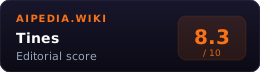
Tines is the workflow automation platform built for security and IT teams that need every run logged, reviewable, and automation-ready. Founded by former security operators in 2018, Tines is co-headquartered in Dublin and Boston. It reached unicorn status with a $125M Series C in February 2025, bringing total funding to $272M.
The platform differentiates itself from general-purpose automation tools like Zapier and Make by treating SOC 2, SSO/SAML, role-based access, hosting flexibility, and audit logging as first-class features. Workbench lets builders chat with connected systems and run actions across APIs, while the AI Agent action adds Task and Chat modes for agentic workflows.
As of June 2026, Tines’ AI stack spans Workbench, the AI Agent action, Story copilot, and Automatic mode in Event Transform. Default AI runs on Tines-managed providers and consumes AI run-time credits; paid customers can also bring their own AI model. Important buying caveat: the newer AI Agents introduction says the AI Agent action is available on all Tines tenants as of February 10, 2026, but package limits, credits, and custom-model terms still decide real production capacity.
System Verdict
Pick Tines if you run a SOC, IT ops, or compliance function and need automation runs that hold up in audit. The platform logs actions, supports SSO/SAML and role-based controls, offers flexible hosting on Business and Enterprise, and connects to security systems through templates, APIs, and integrations. Workbench and AI Agent actions add controlled AI interaction on top of the same workflow runtime.
Skip it if you are a marketing operator, solo founder, or growth team shopping for cheap app-to-app glue. The $500/mo Starter floor is steep for anyone who would otherwise pay $20 to Zapier or Make. Tines also lacks the 5,000+ integration catalog those tools ship. If your workflows do not need audit trails, you are paying for capabilities you will not use.
Who pays which tier: Community free for evaluation and personal flows, Starter starting at $500/mo for lean teams starting production automation, Business and Enterprise (contact sales) for organization-wide workflow programs, flexible hosting, advanced security, and dedicated support. AI Agent action availability is broader than the old FAQ wording, but usage still consumes AI run-time credits.
Key Facts
| Flagship AI surfaces | Workbench, AI Agent action, Story copilot, Automatic mode |
| Integrations | Templates, Send to Story, APIs, and any service with an API |
| Agent mode | AI Agent action with Task and Chat modes |
| LLM backend | Tines default AI plus optional customer-provided models on paid editions |
| Community tier | Free forever: 1 user, 3 flows, 25K events/mo, 50 AI run-time credits |
| Starter | Starts at $500/mo: 5-20 flows, 2-5 users, 1M monthly events, 2,500-10,000 AI run-time credits |
| Business | Contact sales: 30+ flows, 100 users, 1.5M daily events, AI Agent action, self-hosting available |
| Enterprise | Contact sales: dedicated cloud tenant, self-hosting, enterprise controls |
| Compliance | SOC Type II, audit logs, SSO/SAML, role-based access, Trust Center documents under NDA |
| Founded / HQ | 2018, Dublin and Boston |
| Funding | $272M total, $125M Series C Feb 2025, $1.125B valuation |
| Investors | Growth Equity at Goldman Sachs, SoftBank, Activant, Accel, Felicis, CrowdStrike, Addition |
Every data point above was verified against vendor or company-source pages on 2026-06-12. See Sources.
What it actually is
A no-code workflow builder with a visual canvas. Each “story” (Tines’ name for a workflow) chains actions like HTTP requests, transforms, and conditional logic. Every step records inputs, outputs, and who triggered it.
Workbench sits on top. Builders can chat with connected data sources and kick off actions in natural language. The AI Agent action is different: it lives inside workflows and can run in Task mode or Chat mode with explicitly configured tools.
The real moat: Tines treats every run like evidence. Logs are immutable, credentials live in encrypted stores, and the same workflow runs identically across environments. That is how SOCs survive audits.
When to pick Tines
- SOC and incident response automation. Native connectors to CrowdStrike, SentinelOne, Splunk, and PagerDuty mean you are not writing custom HTTP wrappers for every alert route.
- Regulated industries with audit requirements. Tines publishes SOC Type II, audit logs, SSO/SAML, Trust Center documents, and hosting controls for regulated reviews.
- Agentic workflows with explicit controls. The AI Agent action runs in Task mode for autonomous workflow steps or Chat mode for user-facing AI pages. The June 9 check found newer AI Agents documentation saying the action is available on all tenants, while usage still consumes AI run-time credits, so confirm credits and edition scope on quote.
- IT ops and compliance teams replacing spreadsheet-driven runbooks. Case and incident management ships in Business and Enterprise tiers.
- Multi-team enterprise deployments. Business and Enterprise bring flexible hosting, advanced security controls, support/training, and broader workflow program management.
When to pick something else
- Consumer-app glue on a budget: Zapier or Make. 5,000+ integrations and single-digit monthly pricing.
- Self-hosted open-source automation: n8n or Activepieces. Free if you run your own infrastructure.
- AI-native sales and back-office agents: Lindy or Gumloop. Built around LLM-first UX rather than security compliance.
- Marketing operators wanting a cheap Zap clone: Zapier or Make again. Tines is overkill.
Pricing
Pricing via tines.com/pricing:
| Plan | Price | Limits | Who’s it for |
|---|---|---|---|
| Community | $0 | 1 user · 3 flows · 25K events/mo · 50 AI run-time credits | Solo evaluation, personal flows |
| Starter | Starts at $500/mo | 2-5 users · 5-20 flows · 1M monthly events · 2,500-10,000 AI run-time credits | Lean security teams starting production automation |
| Business | Contact sales | 100 users · 30+ flows · 1.5M daily events · AI Agent action · self-hosting available · dedicated support/training | Multi-team SOC, IT, and compliance programs |
| Enterprise | Contact sales | All limits contact-Tines · dedicated cloud tenant · self-hosting · enterprise controls | Regulated enterprises with isolation, hosting, or governance requirements |
All tiers include unlimited parallel workflow runs. Tines’ pricing explainer says enhanced packaging launched for new customers on June 25, 2025, and the current feature-set list is accurate as of May 1, 2026. Business and Enterprise add flexible hosting, advanced workflow/security bundles, and self-hosting. The Tines Startup Program discounts access for companies under 100 employees, under $50M raised, and under 5 years old.
Published list pricing for Business and Enterprise is not posted. Treat any third-party quote ranges as directional only until Tines returns an order form.
Prices verified 2026-06-12 via tines.com/pricing, the Tines pricing explainer, and the Tines AI Agents intro.
Against the alternatives
| Tines | Zapier | n8n | Make | |
|---|---|---|---|---|
| Primary audience | SOC / IT / compliance | Marketing / ops | Developers | Ops / marketing |
| Integration count | Templates, security apps, and any API | 5,000+ | 400+ | 1,500+ |
| Audit-grade logging | First-class | Basic | Self-hosted only | Basic |
| Agent mode | AI Agent action / Workbench | Zapier Agents | AI nodes | AI nodes |
| Self-host option | Enterprise only | No | Yes (free) | No |
| Entry price | $0 (3 flows) / $500 Starter | $19.99/mo | $0 (self-host) | $9/mo |
| Best viewed as | Security automation OS | Consumer integration hub | Open-source workflow engine | Visual scenario builder |
Failure modes
- Starter floor is $500/mo. There is a genuine cliff between Community and Starter. Small teams outgrowing Community cannot incrementally buy one more flow.
- App catalog is not the point. Tines can connect to APIs and has many templates, but marketers and revenue-ops teams will still find Zapier’s app catalog easier for commodity SaaS glue.
- Business and Enterprise pricing is opaque. Expect sales cycles, not self-service. Budget for procurement overhead.
- AI Agent usage is credit- and package-sensitive. The current AI Agents intro says the AI Agent action is available on all tenants, but every AI Agent action uses AI run-time credits. Confirm credits, top-up pricing, and custom-model behavior before buying specifically for agents.
- Custom AI models change the cost model. Tines default AI consumes AI run-time credits; custom AI models do not use those credits, but require your own model contract and governance.
- Agent autonomy is still a control problem. Deterministic workflows are mature; fully autonomous runs still need human-in-the-loop checkpoints for production incident response.
- Learning curve for non-security operators. The platform’s mental model assumes familiarity with webhooks, auth flows, and IR playbooks. Marketing users trip over that.
- Action-based pricing model. Event/credit counts scale with run volume. High-frequency polling workflows can burn through tier caps faster than expected.
Methodology
This page was produced by the aipedia.wiki editorial pipeline, an automated system that ingests vendor documentation, verifies pricing and product details against primary sources, and generates the editorial analysis you are reading. No individual human wrote this review. Scoring follows the four-dimension rubric at /about/scoring/ (Utility × Value × Moat × Longevity, unweighted average). Last verified 2026-06-12 against tines.com/pricing, the Tines pricing explainer, the Tines AI Agents intro, AI in Tines, and Tines security.
FAQ
Is Tines free to use? Yes. The Community tier is free forever and includes 1 builder, 3 flows, 25,000 events per month, and 50 AI run-time credits. Paid tiers start at $500/mo with Starter.
What does Tines Workbench do? Workbench is the builder-facing AI chat layer. Tines describes it as a natural-language interface for interacting with data, taking action on workflows, and monitoring real-time scenarios without switching across applications.
Does Tines have AI agents? Yes. Tines has an AI Agent action with Task and Chat modes. Task mode is for autonomous workflow steps; Chat mode creates AI-powered pages for end users. The newer AI Agents intro says the action is available on all tenants as of February 10, 2026; confirm practical credits, limits, and support scope on quote before buying.
How does Tines compare to Zapier? Tines is security-first with audit logs, SOC Type II, SSO/SAML, role-based controls, and API-oriented workflow building. Zapier is consumer-app-first with 5,000+ integrations and a $19.99/mo floor. Pick Tines for SOC and compliance. Pick Zapier for marketing and ops glue.
Can I self-host Tines? Dedicated infrastructure is available on the Enterprise tier. There is no free self-hosted community build. For fully self-hosted open-source automation, use n8n or Activepieces.
Which LLM does Tines use? Tines says its default AI features use tenant-scoped large language models and lists Anthropic Claude, OpenAI GPT, and Amazon Nova models among available options, with availability depending on tenant region. Starter, Business, and Enterprise customers can bring their own AI model. Custom AI models do not use Tines AI run-time credits, but they still need a separate model/provider setup.
Does Tines have an API? Yes. Tines exposes its own REST API for programmatic control over stories, actions, and runs. It also acts as an API orchestration layer for any upstream or downstream system.
Related
- Category: AI Automation
- Alternatives: Zapier · Make · n8n · Activepieces · Gumloop · Lindy
Sources
- Tines pricing: current public editions, Starter price floor, rendered plan limits, startup program eligibility
- Tines pricing explainer: May 2026 packaging, edition comparison, usage limits, feature sets, self-hosting notes
- Tines AI Agents intro: AI Agent action availability, Task and Chat modes, and AI run-time credit usage
- Tines AI Agent FAQ: AI Agent action modes, availability, tools, credit reporting
- AI usage and credits: monthly AI run-time credits, top-ups, custom AI model caveat, model options
- AI in Tines: AI interaction layer, Workbench, agents, MCP positioning, privacy/security claims
- Tines security: SOC Type II, audit logs, SSO/SAML, hosting, Trust Center documents
- Tines about: founder background and 2018 origin
- Tines Series C release: $125M Series C, $1.125B valuation, $272M total funding
Review History
- 2026-04-17: New page. Pricing and features verified against Tines sources.
- 2026-05-10: Refreshed current pricing and packaging; corrected Starter limits, AI Agent action availability caveat, AI credit language, security/source provenance, and visible verification dates.
- 2026-05-13: Reverified packaging against the May 1, 2026 Tines pricing explainer. Updated Starter to reflect the now-published 5-20 flow, 2-5 user, 2,500-10,000 AI credit ranges and AI Agent action inclusion. Flagged the conflict with the older AI Agent FAQ.
- 2026-06-09: Rechecked Tines pricing, packaging, and AI Agents docs. Updated AI Agent copy to reflect the newer “available on all tenants” documentation while keeping credit and package-limit procurement caveats.