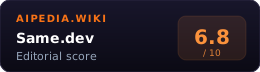
A browser-based AI app builder that generates web applications from a prompt, image, or reference URL. The signature move is clone-from-URL: paste a target site, Same rebuilds the UI, then lets you refine the project in a browser workspace with live preview.
Competes directly with Bolt, Lovable, v0, and Replit Agent. The differentiator is design cloning, a browser-first edit loop, and an official docs surface around Next.js apps, GitHub, Neon, Supabase, Clerk, and deployment.
Pricing is token-metered with a 500K free tier and four paid tiers from $10 through $100. Overage is pay-as-you-go at $10 per 2M tokens expire at the end of each billing cycle.
System Verdict
Pick Same.dev if you need a fast design-driven prototype and want cloning from an existing URL as a first-class feature. The browser-first workflow, live preview, and prompt editing make it strong for first drafts, rebuilds, landing pages, and simple app prototypes. Free is enough to test; Pro is the sensible active-builder tier.
Skip it for production-critical code or deep customization. Same is built around a hosted browser workflow. The docs now make clear that custom deployment control, code download, and external hosting paths depend on paid/export/GitHub/Netlify choices, so regulated or long-lived apps still need engineering review.
Who pays which tier: Free for exploration and one-off clone tests, Basic $10/mo for solo tinkerers with 2M tokens, Pro $25/mo for active builders shipping multiple prototypes, Max $50/mo for heavier workflows, Ultra $100/mo when the 20M-token pool plus overage terms are cheaper than stopping work.
Key Facts
| Company | Same |
| Launched | 2024 (browser-based AI app builder wave) |
| Flagship feature | Clone-from-URL (paste a site, get a rebuilt app) |
| Stack | Next.js-oriented web apps with integrations for GitHub, Neon, Supabase, and Clerk |
| Interface | Browser-based IDE with live preview |
| Pricing model | Token-metered, monthly reset, expire at cycle end |
| Free tier | 500,000 tokens/mo |
| Paid entry | Basic at $10/mo (2M tokens) |
| Top tier | Ultra at $100/mo (20M tokens) plus $10 per 2M overage |
| Deployment | Same/Netlify deployment flow; custom domain control requires claiming the deployment |
What it actually is
A hosted vibe-coding platform where the development loop runs in-browser. Users type a prompt, upload an image, or paste a URL; Same generates a web app, renders live preview, and can deploy through its hosted flow.
Clone-from-URL is the signature. Paste https://example.com and Same reconstructs the UI, infers layout, and scaffolds comparable components. This is useful for design reference, competitive rebuilds, or porting a Figma-exported site into real code.
Download and remix on paid tiers lets users export the project or branch existing ones. This is the main path off the hosted workflow when a project outgrows Same’s defaults.
Deployment is convenient but not equivalent to owning the infrastructure. Same’s deployment docs describe a Netlify-backed flow, custom-domain control through claiming a deployment, and unclaimed deployments that can expire after 14 days of inactivity. Treat deploy as a prototype path until you have claimed/exported and reviewed the app.
Token metering replaced Same’s older pay-as-you-go Pro model. Unused tokens do not roll over. Ultra tier adds pay-as-you-go overage at $10 per 2M tokens, which is useful for spiky workloads.
When to pick Same.dev
- Design cloning from a URL. First-class feature, no extra plugin. Closest competitor requires separate screenshot-import steps.
- Greenfield web-app prototypes. Same starts from prompts, URLs, or images, then supports app logic, deployment, and integrations without a local setup.
- Non-coders shipping prototype apps. The browser interface lowers the floor more than Cursor or Claude Code, which assume a local dev environment.
- Design-led iteration with live preview. Change prompt, see result. Tight feedback loop for UI work.
- Token-budgeted projects. Five plans cover hobbyists through heavier builders, and Ultra’s overage terms work for spiky usage better than hard caps.
When to pick something else
- Bolt-native StackBlitz WebContainer workflow: Bolt. More mature sandbox, strong npm ecosystem support in-browser.
- Lovable’s Supabase-first stack: Lovable. Tighter Supabase integration, different pricing philosophy.
- v0 for shadcn / Next.js UIs: v0. Vercel-native, best-in-class for React component generation.
- Replit full-hosted dev environment: Replit Agent. Longer heritage, broader language support, better for backend-heavy apps.
- Professional IDE workflow: Cursor or Windsurf. Local environment, full repo control, richer refactor tools.
- Terminal-first agent on an existing codebase: Claude Code. Strongest agent for real engineering work.
- Design-first marketing sites: Framer AI. Better typography and animation primitives for landing pages.
Pricing
Verified 2026-06-12 via docs.same.new/usage/pricing:
| Plan | Price | Monthly tokens | Key features |
|---|---|---|---|
| Free | $0 | 500,000 | Browser build flow, live preview, deploy |
| Basic | $10/mo | 2,000,000 | Premium model, download & remix projects |
| Pro | $25/mo | 5,000,000 | Premium model, download & remix projects |
| Max | $50/mo | 10,000,000 | Premium model, download & remix projects |
| Ultra | $100/mo | 20,000,000 | Pay-as-you-go overage at $10 per 2M tokens |
| Enterprise | Custom | Custom | Contact for custom plans |
Token rollover: unused tokens expire at the end of each billing cycle across all plans.
Overage: Ultra tier is the only plan with pay-as-you-go overage built in. Lower tiers cap at the monthly pool.
Prices verified 2026-06-12 via Same pricing docs, quickstart, and deployment docs.
Against the alternatives
| Same.dev | Bolt | Lovable | v0 | |
|---|---|---|---|---|
| Best starting point | URL/image/prompt clone into a Same project | In-browser dev sandbox | Supabase-first app builder | React / shadcn UI generation |
| Signature feature | Clone-from-URL | StackBlitz WebContainer | Supabase-native stack | shadcn / Next.js output |
| Backend path | Next.js plus integrations | Full-stack sandbox | Supabase-led | Usually paired with Vercel app code |
| Deploy path | Same/Netlify flow | Bolt deployment flow | Lovable deployment flow | Vercel-native |
| Export/control risk | Download is paid; custom domains require claiming deployment | Check current export and token terms | Check Supabase/project export terms | Check v0/Vercel credit and deployment billing |
| Best viewed as | Design-cloning app builder | Sandbox app builder | Supabase-first builder | React component generator |
Failure modes
- Hosted workflow limits deep backend control. Integrations cover common auth, database, GitHub, and deployment needs, but serious apps still need export, repo review, and infrastructure decisions.
- Token expiration stings. Unused tokens disappear at cycle end. Light-usage months are wasted on mid-tier plans.
- Clone-from-URL misreads complex layouts. Heavily-dynamic sites (dashboards, complex forms, infinite scroll) rebuild imperfectly. Treat the output as a starting point.
- Production-readiness gap. Auth flows, data-model choices, and security posture of generated apps need hardening before real users hit them.
- Lock-in risk on free tier. Download and remix are paid-tier features. Free-tier projects need an upgrade to leave the platform cleanly.
- Unclaimed deployments are not permanent infrastructure. Same’s deployment docs say unclaimed deployments can expire after 14 days of inactivity.
- Smaller ecosystem than Replit or Bolt. Community templates, plugins, and third-party integrations are thinner.
- Pricing tier proliferation. Five consumer tiers plus enterprise is more segmentation than the category average. Pick-a-plan fatigue is real.
Methodology
This page was produced by the aipedia.wiki editorial pipeline, an automated system that ingests vendor documentation, verifies pricing and product details against primary sources, and generates the editorial analysis you are reading. No individual human wrote this review. Scoring follows the four-dimension rubric at /about/scoring/ (Utility × Value × Moat × Longevity, unweighted average). Last verified 2026-06-12 against Same quickstart, FAQ, deploy, integrations, and pricing docs.
FAQ
Is Same.dev free? Yes. Same’s pricing docs list a free plan with 500,000 tokens per month. Paid plans start at $10/mo Basic.
What is clone-from-URL? Paste any public site into Same.dev and it reconstructs the UI as a new web app. Useful for design reference, competitive teardowns, and porting existing sites into real code.
How does Same.dev compare to Bolt and Lovable? Same’s signature differentiator is URL-based design cloning. Bolt leans on StackBlitz WebContainers for in-browser development, Lovable prioritises a Supabase-first backend stack. All three can ship fast web-app prototypes, but their export, deployment, and usage-pricing details differ.
Can I export my project? Yes, on paid tiers. Download and remix are Basic-and-up features in Same’s pricing docs. Free tier projects need an upgrade to export cleanly.
Do unused tokens roll over? No. All unused tokens expire at the end of each billing cycle.
What happens if I exceed my token pool? On Free through Max, usage caps at the pool. On Ultra, pay-as-you-go kicks in at $10 per additional 2 million tokens.
Can I use Same.dev for production apps? For prototypes and internal tools, yes. For regulated or compliance-heavy production workloads, export or sync the project, move it into a standard repo workflow such as Cursor or Claude Code, and harden auth, data models, deployment, and security before launch.
Related
- Category: AI Coding
- Direct alternatives: Bolt · Lovable · v0 · Replit Agent
- Pro IDE alternatives: Cursor · Windsurf · Claude Code · Trae