Originally a San Francisco startup founded in November 2022 by Arnaud Benard (ex-Google, Faire) and Helen Zhou (ex-Meta, Cruise). The product generated UI mockups from text prompts and exported them to Figma.
Google acquired Galileo AI in May 2025. The team and the product relaunched as Google Stitch, powered by Gemini. The standalone Galileo product and its paid tiers are retired.
System Verdict
Pick the current product, Google Stitch, if AI-native UI exploration at zero public cost is the goal. Stitch is free through Google Labs and now centers on a design canvas, natural-language UI creation, images/text/code as context, design agents, voice critique, interactive prototypes, DESIGN.md, MCP/SDK, and exports to developer tools. That is a wider direction than the legacy Galileo subscription delivered at $19-$39/mo.
Skip it if the workflow favors a coder-first route. v0 converts prompts to production React. Figma’s own Figma Make generates components inside an existing Figma file. Stitch generates independent design output that still needs hand-off into code.
About the legacy brand: the standalone Galileo product is retired. New users should land on stitch.withgoogle.com. Historical Galileo subscriptions have been wound down. See the founders’ own acquisition note and Google’s current Stitch announcement.
Key Facts
| Current product | Google Stitch (powered by Gemini) |
| Previous product | Galileo AI (standalone text-to-UI tool) |
| Acquisition | Google, May 2025 |
| Founders | Arnaud Benard, Helen Zhou |
| Generation mode | Natural-language UI creation, images/text/code as context, voice critique, interactive prototypes |
| Handoff targets | DESIGN.md, MCP server, SDK, Skills, and developer-tool exports |
| Pricing today | Free through Google Labs |
| Usage cap | Not published as a durable public Google pricing term |
| Legacy pricing | Free (3 exports), Standard $19/mo, Pro $39/mo (retired 2025) |
| API | None publicly available |
Every data point above was re-verified against vendor and third-party sources on 2026-06-12. See Sources.
What it actually is
A text-to-UI and vibe-design canvas. Users type a prompt or business objective, add examples or context, and Stitch returns high-fidelity UI directions that can be refined on an infinite canvas and stitched into prototypes.
The product direction changed when Google acquired the team in May 2025. Stitch inherits Google’s Labs and Gemini-era infrastructure, with a March 2026 expansion around AI-native canvas work, design agents, voice interaction, DESIGN.md, MCP, SDK, and developer-tool handoff.
The legacy Galileo brand exists only as a historical reference. Search traffic still lands on “Galileo AI” queries, but the product itself is Google Stitch now.
When to pick Galileo AI (Google Stitch)
- Early-stage UI mockups cost nothing on the public Labs surface. Free Labs access beats paid generators for exploration, while quota and account limits still need live verification.
- Voice input fits on-the-go ideation. Describing a screen verbally skips the formal prompt-writing step and supports critique-style iteration.
- Interactive prototypes cut iteration time. Stitch can connect screens and generate next-screen directions so teams can test a flow before rebuilding it in Figma or code.
- DESIGN.md and MCP matter for handoff. The current Google direction is not just screenshots; it is agent-friendly design context that can move into developer tools.
- Developer-tool exports cover the design-to-code gap. Treat the output as scaffolding to review, not production code to ship automatically.
When to pick something else
- Prompt-to-production React app: v0. Vercel’s tool outputs shadcn/ui React components ready to deploy. Stitch outputs designs that still need a coder.
- Design edits inside an existing Figma file: Figma Make. Native Figma AI generates components in the same canvas as existing design work, which Stitch does not do.
- Component-library rewiring for a marketing site: Relume. Better at section-level layouts than full-app UI.
- Pixel-perfect brand work: neither Stitch nor any generator replaces a senior product designer. Use them for a draft, not a final.
- Teams avoiding Google Labs data terms: Stitch ships under Labs beta terms that permit Google to use inputs for model improvement. Privacy-sensitive workflows need review before adoption.
Pricing
Google Stitch is free through Google Labs as of June 12, 2026. No Google-published paid tier, durable quota table, SLA, or billing schedule is public.
| Plan | Price | Generations per month | Who’s it for |
|---|---|---|---|
| Google Stitch (Labs) | $0 | Not published as a durable public Google quota | Everyone testing the current Labs product |
Legacy Galileo AI plans (all retired after the Google acquisition in May 2025):
| Legacy plan | Price | Status |
|---|---|---|
| Free | $0 (3 Figma exports) | Retired |
| Standard | $19/mo (1,200 credits) | Retired |
| Pro | $39/mo (3,000 credits) | Retired |
| Enterprise | Custom | Retired |
Pricing re-verified 2026-06-12 via Google Stitch, Google’s March 2026 Stitch announcement, and the founders’ acquisition announcement. Third-party quota reports are intentionally not treated as stable Google public pricing terms.
Against the alternatives
| Google Stitch (ex-Galileo) | v0 | Figma Make | |
|---|---|---|---|
| Price | Free (Labs beta) | Free tier + paid | Included in Figma paid plans |
| Primary output | UI concepts, prototypes, DESIGN.md/MCP/SDK/export handoff | React + shadcn/ui components | Native Figma layers |
| Multi-screen generation | Interactive prototype and next-screen exploration | Single-page focus | Component-level |
| Voice input | Yes (Stitch 2.0) | No | No |
| Runs inside existing Figma file | No | No | Yes |
| Production code output | Indirect via developer-tool handoff | Direct React | Indirect via dev mode |
| Best viewed as | Free design prototyping | Prompt-to-app for coders | AI inside Figma canvas |
Failure modes
- The Galileo brand is retired. Landing on usegalileo.ai redirects or directs users to Stitch. Tutorials, YouTube videos, and older reviews reference a product that no longer operates standalone.
- Google Labs beta is not a commitment. Labs products get reshaped or retired on Google’s timeline. Stitch 2.0 landed March 2026; the next change is not guaranteed to preserve the current feature set or free pricing.
- Generation quality varies with prompt. Vague prompts produce generic screens. Specific prompts with named components and layout cues produce better output.
- Design systems are not respected. Stitch generates from Gemini’s prior, not from an uploaded brand kit. Output needs a designer pass to match existing visual language.
- Data terms differ from paid SaaS. Labs beta programs typically permit input use for model improvement. Teams with contractual data restrictions should validate terms before using Stitch on client work.
- No mature procurement surface. Automating Stitch into a CI pipeline or custom design system should wait for stable account, quota, API, data, and support terms.
- Multi-screen output is not a multi-flow output. Five screens per prompt looks similar by default; reaching a coherent app-wide flow takes multiple prompts and manual stitching.
Methodology
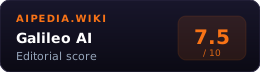
This page was produced by the aipedia.wiki editorial pipeline, an automated system that ingests vendor documentation, verifies pricing and model details against primary sources, and generates the editorial analysis shown here. No individual human wrote this review. Scoring follows the four-dimension rubric at /about/scoring/ (Utility, Value, Moat, Longevity, unweighted average). Last verified 2026-06-12 against Google Stitch, Google’s Stitch announcement, and the founders’ acquisition announcement on X.
FAQ
Is Galileo AI still a separate product? No. Galileo AI was acquired by Google in May 2025 and fully relaunched as Google Stitch, powered by Gemini. The standalone Galileo product and its paid tiers are retired.
What does Google Stitch cost? Stitch is free through Google Labs as of June 12, 2026. Public Google pages do not publish a durable quota, SLA, billing table, or paid-tier schedule, so check the live account screen before building a paid workflow around it.
What happened to my Galileo AI subscription? Legacy paid subscriptions were wound down after the acquisition. Current and former users are directed to stitch.withgoogle.com, which is free.
Which model powers Stitch? Gemini. Google replaced the original Galileo models after the acquisition. Model version details follow the current Gemini release line on Google’s product pages.
Can Stitch export to Figma? Yes. Output exports as layered Figma frames ready for designer cleanup.
Can Stitch export to code? It can hand off designs into developer workflows through DESIGN.md, MCP, SDK, Skills, and developer-tool exports. Output still requires developer review before production use.
Stitch or v0 for prompt-to-app? v0 for coder-first workflows that need React components today. Stitch for design-first workflows that start from a visual concept and hand off to developers later.
Does Stitch work inside an existing Figma file? No. That is Figma Make’s territory. Stitch generates standalone output that lands in Figma as a new file or frame.
Related
- Category: AI Design · AI Automation
- Alternatives: v0 · Figma · Google Stitch
Sources
- Google Stitch: current product and Labs surface
- Google Labs Stitch announcement: March 2026 design canvas, agents, DESIGN.md, MCP, SDK, voice, prototype, and export details
- Arnaud Benard acquisition announcement on X: May 2025 Google acquisition and Stitch rebrand
- Canvas Business Model: Galileo AI history: company founding and funding timeline