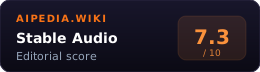
Stable Audio is Stability AI’s music and sound generation product. Stable Audio 3.0 is the current flagship family as of June 12, 2026, and Stability positions it for licensed-data audio generation, open-weight experimentation, API access, sound effects, brand audio, full music composition, and enterprise deployment.
Verified June 12, 2026 against Stability AI’s Stable Audio 3.0 release, StableAudio.com pricing, Stability AI platform/API surfaces, and Stability AI licensing context.
System Verdict
Pick Stable Audio when rights, model access, and deployment options matter more than pop-song polish. Stability says Stable Audio 3.0 models are trained on fully licensed datasets, three of the models are open weights/enterprise path.
Skip it if the job is vocal-first songwriting. Stable Audio is useful for tracks, clips, ambiences, and sound design. If you mainly want lyrics, vocals, hooks, and consumer song structure, compare Suno and Udio first.
Best plan guidance: Developers and researchers should start with Stable Audio 3.0 Small SFX, Small, or Medium open weights, then confirm Community License fit. Organizations with more than $1M annual revenue, platforms, apps, games, film/TV workflows, and self-hosting buyers should go through Enterprise. API buyers should evaluate Stable Audio 3.0 Large through Stability AI’s platform path.
Key Facts
| Current flagship | Stable Audio 3.0 model family |
| Models | Small SFX, Small, Medium, Large |
| Best fit | Instrumental tracks, sfx, ambiences, brand audio, open-weight experimentation, enterprise sound production |
| Max output | Small up to 2 minutes; Medium and Large more than 6 minutes |
| Open weights | Small SFX, Small, and Medium |
| API path | Stable Audio 3.0 Large via Stability AI API |
| Core workflows | Text-to-audio, variable-length generation, audio inpainting/editing/continuation, LoRA customization |
| Training-data claim | Stability says all Stable Audio 3.0 models are trained on fully licensed data |
| Commercial threshold | Community License for qualifying users; Enterprise License for organizations over $1M annual revenue |
| Enterprise path | access, legal indemnification, fine-tuning support, and self-hosting conversations |
What It Actually Is
Stable Audio is a hosted web app plus a Stability AI model family. The current product surface points buyers to StableAudio.com, Hugging Face open weights, the Stability AI API, partner platforms such as ComfyUI, and enterprise licensing.
Stable Audio 3.0 is a four-model family. Small SFX is for on-device sound effects. Small is for on-device full music composition and can generate up to two minutes. Medium improves structure, melodic coherence, phrasing, and length up to 6:20. Large is the advanced API/enterprise model for music platforms and high-volume creative applications.
The strongest buyer reason is not “best song demo.” It is the combination of licensed-training-data positioning, open weights, API access, enterprise licensing, and deployment optionality. Stability says Small SFX, Small, and Medium are open weights under the Community License, while organizations with more than $1M in annual revenue need Enterprise coverage.
When To Pick Stable Audio
- Licensed-data instrumental work: brand beds, podcast bumpers, product sounds, sfx, game audio, ad concepts, and ambient tracks.
- Rights-sensitive audio workflows: teams that care about the training-data story before they care about the flashiest vocal demo.
- Open-weight experimentation: developers who want local/on-device model access for Small SFX, Small, or Medium.
- API audio generation: developers who want the Stable Audio 3.0 Large API path.
- Enterprise sound production: organizations that need custom deployment, implementation support, fine-tuning on a sound library, legal indemnification, or self-hosting discussions.
When To Pick Something Else
- Full songs with vocals and lyrics: Suno or Udio.
- Composer-led scoring and MIDI control: AIVA.
- Background music beds at scale: Mubert.
- Voice, narration, or dialogue: ElevenLabs.
- No-license-review deployment: do not assume open weights mean unrestricted use. Check Stability AI’s current license before shipping.
Pricing
Stable Audio now has two different buyer surfaces that should not be collapsed: Stable Audio 3.0 model access and the hosted StableAudio.com subscription checkout.
| Surface | Price signal | License/access signal | Best for |
|---|---|---|---|
| Stable Audio 3.0 Small SFX / Small / Medium | Open weights | Community License; Enterprise for orgs over $1M annual revenue | Developers, researchers, local/on-device experimentation |
| Stable Audio 3.0 Large | API / enterprise | Stability AI API and enterprise self-hosting | Platforms, apps, high-volume creative systems |
| StableAudio.com hosted app | Checkout-confirmed Free/Pro/Studio/Max/Enterprise | Verify current model access and license in checkout | Individual hosted generation workflows |
| Enterprise | Custom | Enterprise License, legal indemnification, fine-tuning support, self-hosting conversations | Organizations, apps, games, film/TV, large deployments |
The old May pricing page data for hosted subscriptions should not be treated as a complete 3.0 procurement model. StableAudio.com is JS-heavy, and Stability’s public API pricing route did not expose stable text to AiPedia’s checker on June 9. Confirm live checkout, API account pricing, model access, license, taxes, and revenue threshold before purchase.
Against The Alternatives
| Stable Audio 3.0 | Suno | Udio | |
|---|---|---|---|
| Best job | Instrumental audio, sfx, brand/enterprise sound | Fast complete songs | Songwriting alternatives and iteration |
| Training-data positioning | Stability claims fully licensed datasets | Rights debate remains a buyer concern | Rights debate remains a buyer concern |
| Vocal/lyric strength | Not the main product focus | Stronger | Stronger |
| Enterprise deployment | Enterprise licensing and self-hosting conversations | Cloud consumer/pro workflow | Cloud consumer/pro workflow |
| API path | Stable Audio 3.0 Large via Stability AI API | Check current developer/API availability | Check current developer/API availability |
| Best viewed as | Rights-sensitive audio asset generator | Consumer song creation default | Consumer songwriting alternative |
Failure Modes
- Commercial rights are easy to misread. Community License coverage is not the same thing as enterprise commercial coverage. Organizations over $1M in annual revenue need Enterprise License review.
- Enterprise is not publicly priced. If you are a company, app, game, film/TV workflow, or high-revenue deployment, expect a sales and legal review.
- Vocal performance is not the core pitch. Stable Audio 3.0 is better framed as licensed-data music/sfx/brand audio and model infrastructure than as a direct vocal-song winner.
- API costs require account-level verification. Stable Audio 3.0 Large is the API path, but live API pricing and account terms should be confirmed before estimating margins.
- Open weights are not a legal shortcut. Small SFX, Small, and Medium are open weights, but usage rights still depend on Stability’s license terms and revenue threshold.
- Category law and platform terms are volatile. AI music rights, upload restrictions, and licensing language can change quickly. Re-check terms before release, distribution, ads, or client work.
Methodology
This page was produced by the aipedia.wiki editorial pipeline, an automated system that ingests vendor documentation, verifies pricing and model details against primary sources, and generates the editorial analysis you are reading. No individual human wrote this review. Scoring follows the four-dimension rubric at /about/scoring/ (Utility x Value x Moat x Longevity, unweighted average). Last verified June 12, 2026 against the Stable Audio 3.0 launch, Stable Audio pricing, Stability AI platform pricing, and Stability AI licensing.
FAQ
Is Stable Audio free? Partly. Stable Audio 3.0 Small SFX, Small, and Medium are open weights under Stability’s Community License. Hosted-app access and Stable Audio 3.0 Large/API access are separate buyer paths.
Which Stable Audio plan should I buy for commercial use? If you are under the Community License threshold, test the open weights and confirm the current license terms. If you are an organization with more than $1M annual revenue, an app/platform, or a high-stakes commercial deployment, use Enterprise.
What is the current Stable Audio model? Stable Audio 3.0 is the current flagship family. It includes Small SFX, Small, Medium, and Large. Medium and Large generate more than six minutes; Large is available through the Stability AI API and enterprise deployment path.
How much does the Stable Audio API cost? Stable Audio 3.0 Large is available via the Stability AI API, but live API pricing should be confirmed in your platform account before building a margin model. The public pricing route did not expose stable text to AiPedia’s checker on June 9, 2026.
Can I use Stable Audio output commercially? Yes, but only under the right license. Stability says users own Stable Audio 3.0 outputs and can distribute/commercialize under the Community License, while organizations with more than $1M in annual revenue should use the Enterprise License.
Is Stable Audio trained on licensed data? Stability AI says all Stable Audio 3.0 models are trained on fully licensed data. That is a major reason to consider it for brand and enterprise workloads, but buyers should still review the current license and terms before release.
Does Stable Audio export stems? The current official product and pricing pages I verified do not make native stem export the central claim. Treat Stable Audio as text/audio-to-audio and inpainting for generated audio, then check the live app for export options before building a DAW workflow around it.
Stable Audio 3.0 vs Stable Audio Open 1.0, which should I use? Use Stable Audio 3.0 for the current model family. Stable Audio Open 1.0 is older and shorter-output. For 3.0, Small SFX, Small, and Medium are open weights; Large is the API/enterprise model.
Can I deploy Stable Audio on-premises? Enterprise conversations can include self-hosting, custom deployment, fine-tuning support, legal indemnification, and Stable Audio 3.0 Large access. Open weights are useful, but they are not a blanket enterprise license.
Sources
- Stable Audio 3.0 launch: Small SFX, Small, Medium, Large, open weights, licensed training data, Community/Enterprise licensing, API/self-hosting, max lengths
- Stable Audio pricing: hosted app pricing route and checkout-confirmation surface
- Stability AI platform pricing: API pricing route
- Stability AI license: Community and Enterprise licensing context