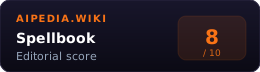
Spellbook is a legal AI copilot built around Microsoft Word contract work. The Word add-in reviews, drafts, asks questions, benchmarks clauses, and runs playbooks inside the document. Spellbook Associate is the separate web/desktop workspace for multi-document tasks such as comparing files, revising templates from reference material, and asking questions across a deal package.
The company launched the first GenAI contract review tool in 2022 as Rally, then rebranded to Spellbook. In October 2025, Khosla Ventures led a $50M Series B, and Spellbook said it had grown to 4,000 law firms and in-house legal teams in 80 countries. Its current pricing page says more than 4,400 in-house teams and law firms use Spellbook worldwide.
Recent developments
- June 9, 2026: AiPedia rechecked Spellbook’s live pricing page. The public page still uses custom pricing based on license-team size, keeps a 7-day free trial, includes Word Add-In plus Associate in the suite, and foregrounds security/private-data claims including Zero Data Retention agreements, SOC 2 Type II, GDPR, and CCPA.
- May 12, 2026: Anthropic launched Claude for Legal with 12 practice-area plugins, 20-plus MCP connectors (Harvey, Relativity, Everlaw, Thomson Reuters CoCounsel, DocuSign, Box), and a Microsoft 365 integration that embeds Claude across Word, Outlook, Excel, and PowerPoint. Freshfields, Quinn Emanuel, Holland & Knight, and Crosby joined as launch customers. The Claude inside Word surface is the first frontier-lab product that directly contests Spellbook’s positioning, although Anthropic is sitting under partners like Harvey rather than replacing the vertical product layer. Spellbook buyers should ask how the team plans to coexist with or differentiate against Claude for Legal on the Word add-in, playbook codification, and contract market data.
Pricing is custom and quote-based. Spellbook says pricing is structured around the number of team members on the license, and lawyers can try Spellbook free for 7 days. Security coverage is strong for the segment: SOC 2 Type II, HIPAA controls, GDPR/CCPA/PIPEDA privacy coverage, zero-data-retention agreements with OpenAI and Anthropic, and an independent low-risk EU AI Act classification opinion.
System Verdict
Pick Spellbook if you are a solo attorney, small firm, or in-house legal team doing transactional contract work in Microsoft Word. The product’s positioning is the moat: most competitors ship as a separate web app or a firm-wide platform. Spellbook lives inside the document lawyers already edit, while Associate handles multi-document workflows with lawyer oversight.
Skip it when public price certainty matters. Spellbook no longer publishes a fixed entry price, and third-party trackers conflict. Skip it for litigation research. Spellbook is tuned for commercial drafting and review, not case law, pleadings, or discovery. Skip it if your team works outside Microsoft Word. Associate helps with multi-document matters, but the core drafting loop remains Word-centered.
Who pays which tier: Start with the 7-day trial for hands-on contract review. Request a quote before buying for a team, because official pricing depends on license size and support needs. Larger in-house teams should explicitly ask whether Playbook Build Service, dedicated support, security documents, and training are included.
Key Facts
| Company | Spellbook Legal (formerly Rally), St. John’s, Newfoundland |
| Founded | 2018 as Rally · rebranded Spellbook 2023 |
| Flagship launch | 2022 (first GenAI contract review tool, per Spellbook) |
| Funding | $50M Series B led by Khosla Ventures (Oct 2025) |
| Deployment | Microsoft Word add-in plus Associate web/desktop app |
| LLM/data posture | OpenAI and Anthropic zero-data-retention agreements; verify live model routing in procurement |
| Market data | 2026 report includes 270+ clause benchmarks across 13 agreement types |
| Users | 4,400+ legal teams worldwide; 80-country footprint cited in Series B post |
| Key features | Review · Draft · Ask · Benchmarks/Market · Playbooks · Associate |
| Compliance | SOC 2 Type II · HIPAA controls · GDPR/CCPA/PIPEDA · EU AI Act low-risk opinion · ZDR |
| Pricing | Custom quote based on team members |
| Free trial | 7 days |
What it actually is
Spellbook has two surfaces. The Word add-in is the core drafting and single-document review surface. Associate is the multi-document workspace for deal packages.
In Word, lawyers open a contract and use Spellbook against the active document without moving the drafting loop to a separate editor. Five core functions sit in the suite:
- Review. Flags risks, missing clauses, and deviations from market standard.
- Draft. Generates clauses from natural-language instructions or saved precedent.
- Ask. Answers questions about the document with citations to specific clauses.
- Benchmarks / Market. Compares contract language to Spellbook’s market data.
- Playbooks. Codified team rules for how specific clauses should be drafted or reviewed.
- Associate. Multi-document agent for comparing documents, revising templates from reference materials, and asking questions across files.
Spellbook’s public model claims need procurement verification. Its Word marketing page currently says Spellbook uses GPT5, but older copy on the same page still references GPT-4o. The security page is more useful for risk review: Spellbook says it has zero-data-retention agreements with OpenAI and Anthropic, meaning customer request/response data is not persisted by those LLM providers.
The moat sits on three pillars: the Word integration, proprietary contract market data, and security posture. The 2026 State of Contracts report describes hundreds of thousands of analyzed agreements and 270+ clause benchmarks across 13 agreement types, which is more defensible than generic chatbot drafting.
When to pick Spellbook
- You draft commercial contracts daily inside Microsoft Word. The in-document pane kills the copy-paste loop that every standalone AI tool requires.
- You run a solo practice, small firm, or in-house contract team. Spellbook is built for commercial legal drafting and review, not general-purpose office writing.
- You review deal packages with many related documents. The Associate agent handles multi-document workflows like full-acquisition document reviews.
- You need stronger security posture than commodity AI chatbots. SOC 2 Type II, HIPAA controls, privacy-regulation coverage, and zero-data-retention agreements make it safer for privileged work than consumer-tier ChatGPT or Claude.
- You want to codify team playbooks. Playbooks capture “how our firm drafts MSAs” as reusable AI instructions. In-house legal ops teams use this to standardize across the department.
When to pick something else
- Firmwide platform at BigLaw scale: Harvey. Harvey is the default for 50+ lawyer firms doing litigation plus transactions plus research.
- Pure case law research: Thomson Reuters CoCounsel or Lexis+ AI. Spellbook does not do deep case research.
- Litigation workflows: Litigation-focused platforms like Filevine or Everlaw. Spellbook is a drafting and review tool, not a litigation case manager.
- Free or cheap starter option: Claude Pro at $20/mo or ChatGPT Plus at $20/mo. These lack Word integration, benchmarks, and compliance certifications, but the base drafting capability is strong for lawyers who want to experiment before committing to a legal-specific tool.
- Non-Word environments: Teams living in Google Docs, iWork, or specialized contract lifecycle management (CLM) platforms like Ironclad or LinkSquares. Spellbook is Word-only.
Pricing
Spellbook does not publish fixed per-seat pricing. The official model is custom and quote-based, scaled by the number of team members on the license. Current official guidance:
| Source | Pricing signal | Notes |
|---|---|---|
| Spellbook pricing | Custom quote | Pricing is based on number of team members on the license |
| Spellbook pricing page | 7-day free trial | Larger organizations may be able to arrange extended trials |
| Third-party trackers | Conflicting estimates | Treat as weak evidence; request a quote before budgeting |
The official path is a trial or demo request via spellbook.com/pricing. Do not treat old per-seat figures as current procurement guidance.
The Spellbook Suite includes: Word add-in with Review, Draft, Ask, Benchmarks, and Playbooks. Associate (the multi-document agent) is included. Group or team training sessions are included. Dedicated support applies to teams over 10 users.
Prices verified 2026-06-12 via Spellbook pricing. Fixed per-seat numbers are not publicly disclosed by Spellbook directly.
Against the alternatives
| Spellbook | Harvey | ChatGPT / Claude | |
|---|---|---|---|
| Surface | Microsoft Word add-in | Firmwide web platform | Web chat |
| Core focus | Contract drafting and review | Full-firm research + drafting | General purpose |
| Market data | 270+ clause benchmarks in 2026 report | Firmwide document library | None |
| Multi-document agent | Associate (included) | Built-in | Limited |
| Target buyer | Solo, small firm, in-house | BigLaw, mid-to-large firms | Individual lawyers exploring |
| Pricing | Custom quote | Enterprise, six-figure annual | $20/mo consumer |
| Compliance | SOC 2 II, HIPAA controls, privacy coverage, ZDR | SOC 2 II, firmwide agreements | Consumer-tier (not legal-grade) |
| Best viewed as | SMB legal contract copilot | BigLaw firmwide platform | General AI experiment |
Failure modes
- Opaque pricing. No fixed per-seat number is public. Teams doing comparative budgeting have to request a quote, which slows procurement for small firms.
- Word-only. Teams on Google Docs or iWork cannot use the core product. There is no cross-platform editor integration.
- Not a case research tool. Spellbook is tuned for transactional drafting and review, not case law search or pleadings. Litigators should look elsewhere.
- Model-routing opacity. Public pages mention GPT5, legacy GPT-4o copy, OpenAI, and Anthropic. Buyers should ask which models are active, where data is processed, and whether the quoted plan includes the same model access.
- Harvey ceiling at enterprise scale. Spellbook now sells to larger firms and enterprises, but Harvey remains the clearer default for broad firmwide legal AI that spans research, litigation, and workflow automation.
- New Claude for Legal competition inside Word. Anthropic’s May 12, 2026 Claude for Legal launch puts a frontier-lab assistant directly in Word, Outlook, Excel, and PowerPoint with 12 practice-area plugins and 20-plus legal-tech connectors. Spellbook’s playbooks, contract market data, and Associate workflow remain differentiators, but the Word add-in surface is no longer uncontested.
- Playbook build services may depend on quote. Codifying team-specific playbooks is listed for in-house teams, but buyers should confirm whether it is included in their package.
- 7-day trial is short. Legal procurement cycles rarely fit inside a week. Real evaluation often requires a direct pilot agreement beyond the public trial.
- Canadian data residency. HQ in Newfoundland means some US federal or state procurement policies require extra review before adoption.
Methodology
This page was produced by the aipedia.wiki editorial pipeline, an automated system that ingests vendor documentation, verifies pricing and model details against primary sources, and generates the editorial analysis you are reading. No individual human wrote this review. Scoring follows the four-dimension rubric at /about/scoring/ (Utility x Value x Moat x Longevity, unweighted average). Last verified 2026-06-12 against Spellbook pricing, security, Associate help, legal AI in Word, State of Contracts, and Series B pages, with cross-reference to the May 12, 2026 Anthropic Claude for Legal launch.
FAQ
Is Spellbook free? No. Spellbook runs a 7-day free trial, then moves to custom paid pricing based on the number of team members on the license.
What LLMs does Spellbook use? Spellbook’s current public pages say the Word product uses GPT5, while the security page says Spellbook has zero-data-retention agreements with OpenAI and Anthropic. Ask Spellbook to confirm the live model stack and routing before procurement.
Does Spellbook work outside Microsoft Word? Partly. The core drafting and single-document review product is a Word add-in. Associate is a web/desktop app for multi-document workflows, but teams on Google Docs, iWork, or browser-only drafting workflows cannot use Spellbook’s Word drafting pane.
How is Spellbook different from Harvey? Spellbook is a Word-embedded contract copilot with Associate for multi-document contract workflows. Harvey is a firmwide web platform sold to BigLaw and mid-to-large firms for broader legal AI work. Different surface, different buyer, different budget.
Is Spellbook compliant with legal industry requirements? Spellbook says it is SOC 2 Type II compliant, has HIPAA controls, complies with GDPR/CCPA/PIPEDA, has zero-data-retention agreements with OpenAI and Anthropic, and has an independent legal opinion classifying it as low-risk under the EU AI Act.
Who owns Spellbook? Spellbook Legal, a private company headquartered in St. John’s, Newfoundland. Founded as Rally in 2018, renamed Spellbook in 2023. Last major round: $50M Series B led by Khosla Ventures in October 2025.
Related
- Category: AI Writing · AI Research
- Alternatives: Harvey · Claude · ChatGPT
Sources
- Spellbook pricing: custom pricing, 7-day trial, Word Add-In, Associate, 4,400 legal teams, security/private-data claims
- Spellbook security: SOC 2 Type II, privacy, zero-data-retention, compliance materials
- Spellbook Series B: company history, funding, adoption context