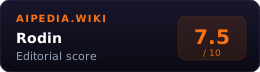
Deemos Tech’s high-detail 3D generator. Rodin Gen-2, a 10B-parameter model released November 6, 2025, is still the production default as of June 2026. The workspace covers text-to-3D, image-to-3D, PBR material generation, part-segmentation, and auto-rigging.
Outputs export to GLB, FBX, USDZ, and OBJ. The API runs on hyper3d.ai and is mirrored on fal.ai for teams that already standardize on that platform.
System Verdict
Pick Rodin if sculpted surface detail is the axis you cannot compromise on. Gen-2’s 10B parameters produce the clearest microstructure of any generally-available 3D model. PBR materials bake at generation time. Part-segmentation is strong enough to drive auto-rigging on humanoids and mechanical assemblies.
Skip it for clean quad topology or cheapest-possible pricing. Tripo3D ships quad remesh as a first-class output and costs less at entry. Meshy has a deeper editor with a 500+ animation library. Luma dropped Genie in favor of Dream Machine video, so that option is gone.
Who pays which tier:, SAML SSO, and custom credit pools.
Key Facts
| Flagship model | Rodin Gen-2 (released November 6, 2025, 10B parameters) |
| Core modes | Text-to-3D · Image-to-3D · PBR material gen · Part-segmentation · Auto-rigging |
| Output formats | GLB · FBX · USDZ · OBJ |
| API access | GA via hyper3d.ai and mirrored on fal.ai |
| Commercial rights | Paid tiers only. Free tier is non-commercial |
| Free tier | Monthly credit allowance with watermark and non-commercial license |
| Platforms | Web app · Blender plugin · REST API |
| Detail axis | Strongest sculpted microstructure in a GA 3D model |
Every data point above was verified against vendor sources on 2026-06-12. See Sources.
What it actually is
One 3D generation product served through a web editor on rodin.deemos.com, a Blender plugin, and a public REST API on hyper3d.ai. The fal.ai mirror gives teams a second route without negotiating a direct Deemos contract.
Rodin Gen-2 handles production workloads. Gen-1 remains available for users who preferred that style. Image-to-3D accepts single and multi-view references. Part-segmentation labels head, torso, limbs, or mechanical components to drive downstream rigging.
Auto-rigging targets humanoid meshes and bipedal characters. Quadruped and mechanical rigs often need manual cleanup.
The moats: the 10B-parameter Gen-2 model produces surface detail competitors have not matched; the part-segmentation pipeline is genuinely differentiated for rigging workflows; and the fal.ai listing under the Tripo3D publisher namespace signals ongoing distribution reach. Weaknesses are triangle-first topology and no bundled animation library.
When to pick Rodin
- You need hero assets for film or advertising. Gen-2 surface detail beats Meshy 5 Preview and Tripo 2.5 on sculpted microstructure and fabric folds.
- Your pipeline can absorb retopology. If you already run ZBrush, Maya, or Blender cleanup passes, Rodin’s dense triangulated output is the best raw material available.
- You need strong part-segmentation. Head, torso, limbs, and mechanical parts come labeled and drive the auto-rigger. Helpful for engineering visualization and character workflows.
- You already use fal.ai. The fal.ai mirror is a first-class endpoint. Teams orchestrating generation through fal get Rodin without a second vendor contract.
- You work in Blender. The official plugin pulls generations into a live scene for iteration.
When to pick something else
- Clean quad topology for game rigging: Tripo3D. Tripo 2.5 ships quad remesh natively, and Rodin does not.
- Deepest editor workspace with bundled animations: Meshy. 500+ rigged animations plus retexture, remesh, and non-destructive editing tools.
- Cheapest starting price: Tripo3D Starter at $10/mo beats Rodin Plus at $15/mo. Meshy also has a real free tier with recurring credits.
- Generative 3D inside a larger consumer product: Luma’s Genie was folded into Dream Machine video. Luma is no longer a direct generative-3D pick.
Pricing
Subscription pricing via hyper3d.ai/pricing. Credits refresh monthly on paid tiers. Annual billing saves roughly 20%.
| Plan | Monthly | Credits | Commercial rights | Who’s it for |
|---|---|---|---|---|
| Free | $0 | Limited monthly, watermarked | No, personal only | Evaluation and hobbyist testing |
| Plus | $15/mo | ~1,500/mo | Yes | Hobbyists and students |
| Pro | $60/mo | ~6,000/mo | Yes | Working artists and small studios land here |
| Enterprise | Custom | Custom | Yes | Volume API, SAML SSO, negotiated credit pools |
Prices verified 2026-06-12 via hyper3d.ai pricing, the docs.hyper3d.ai reference, and the fal.ai Rodin listing. Test credit consumption with your own generation modes before budgeting a production workflow.
Against the alternatives
| Rodin Gen-2 | Tripo 2.5 | Meshy 5 Preview | |
|---|---|---|---|
| Surface detail | Strongest (10B model) | Strong | Strong |
| Topology quality | Triangle-first, dense | Quad remesh native | Triangle-first |
| PBR material bake | Native, high fidelity | Native | Native |
| Part-segmentation | Strongest | Mid | Mid |
| Editor polish | Mid | Minimal | Deepest workspace |
| Animation library | None bundled | None bundled | 500+ rigs |
| Public API | GA plus fal.ai mirror | GA plus fal.ai mirror | GA, own platform only |
| Starting price | $15/mo | $10/mo (cheapest) | $20/mo |
| Best viewed as | Detail specialist | Topology and API specialist | All-in-one workspace |
Failure modes
- Triangle-first topology. Outputs lean dense triangulated meshes. Production rigging pipelines usually need external retopology. Tripo3D wins here outright.
- No bundled animation library. Unlike Meshy, there is no in-app library of rigged animations. Users ship to Blender or Cascadeur for motion.
- Auto-rigging is humanoid-biased. Quadrupeds, insects, and purely mechanical assemblies often need manual rigs.
- Free tier watermarks outputs. Free-tier generations are watermarked and non-commercial. Serious evaluation usually requires Plus at $15/mo.
- Cost per generation is higher than Tripo3D. Heavy API usage is cheaper on Tripo at equivalent credit counts. Run real benchmarks before committing a pipeline.
- Credit accounting is opaque. Credit consumption per generation varies with mode and setting. Heavy users should measure their own prompts.
- Text rendering in textures is weak. Like every 3D generator, Rodin struggles with legible text on surfaces. Bake labels externally.
- Copyright on unmodified outputs is thin. Under U.S. law, purely AI-generated 3D meshes likely have no copyright protection. Substantive human editing strengthens any commercial claim.
Methodology
This page was produced by the aipedia.wiki editorial pipeline, an automated system that ingests vendor documentation, verifies pricing and model details against primary sources, and generates the editorial analysis you are reading. No individual human wrote this review. Scoring follows the four-dimension rubric at /about/scoring/ (Utility × Value × Moat × Longevity, unweighted average). Last verified 2026-06-12 against hyper3d.ai pricing, the Deemos homepage, the docs.hyper3d.ai reference, and the fal.ai Rodin listing.
FAQ
Is Rodin free? A free tier exists with a monthly credit allowance, watermarked outputs, and a non-commercial license. Serious evaluation usually means upgrading to Plus at $15/mo, which removes the watermark and adds commercial rights.
What is the current Rodin model? Rodin Gen-2 is the production default as of June 2026. It was released November 6, 2025 at 10B parameters and produces sharper surface detail, native PBR materials, and improved part-segmentation versus Gen-1. Gen-1 remains selectable for users who prefer its style.
Does Rodin have an API? Yes. The API is generally available via hyper3d.ai and mirrored on fal.ai under the Tripo3D publisher namespace. Credits on the Deemos account and the fal.ai account are separate.
What formats can I export? GLB, FBX, USDZ, and OBJ. PBR material maps (albedo, metallic, roughness, normal) are baked at generation time and included in GLB and FBX exports.
Does Rodin produce quad topology? No. Rodin Gen-2 outputs dense triangulated meshes. Pipelines that need clean quads out of the box should consider Tripo3D instead.
Rodin vs Meshy, which should I use? Rodin if surface detail is your priority and your pipeline can absorb retopology passes. Meshy if you want the deepest editor workspace, a 500+ animation library, and broader format support in one subscription. Most studios end up using both for different stages.
Sources
- hyper3d.ai pricing: plans, credit allocations, commercial rights
- Deemos Tech homepage: company profile and product surface
- docs.hyper3d.ai: API reference, model parameters, credit economy
- fal.ai Rodin listing: third-party API mirror and rate details
Related
- Category: AI Image Generation