Free, MIT-licensed autonomous AI agent from Nous Research (hermes-agent.nousresearch.com). Runs as a persistent server on user infrastructure and connects a CLI plus 15+ messaging platforms from a single gateway.
Three features set it apart from a standard chatbot: persistent memory across restarts, auto-generated skills that the agent writes and refines from experience, and natural language cron scheduling that delivers recurring output to any connected platform.
As of June 12, 2026, the official GitHub release stream is at v0.15.2 and the current docs/README describe a broader platform surface than the early spring build: 15+ messaging platforms, six terminal backends, MCP support, subagents, a Tool Gateway through Nous Portal, and provider switching across Nous Portal, OpenRouter, OpenAI, Anthropic-compatible routes, NovitaAI, NVIDIA NIM, z.ai/GLM, Kimi/Moonshot, MiniMax, Hugging Face, and custom endpoints.
System Verdict
Pick Hermes Agent if a self-hosted assistant that actually remembers and improves is worth setup time. The agent writes procedural skills after multi-step tasks, stores them for reuse, and keeps full-text searchable memory across sessions. Nothing in the managed-SaaS category behaves this way.
Six terminal backends cover most deploy patterns as of the current docs: local, Docker, SSH, Daytona, Singularity, and Modal. Daytona and Modal are the serverless/persistent options for agents that should hibernate between conversations.
Skip it if the user wants plug-and-play. There is no managed cloud. Setup means env vars, Docker, a model API key, and at least one platform integration. ChatGPT or a hosted Zapier agent will be faster to stand up.
Who pays what: route, optional Nous Portal subscription, hosting, and tool providers. Light self-hosted use can be cheap, but always-on agents, browser tools, image/TTS tools, and frontier-model-heavy workflows need spend limits.
Key Facts
| License | MIT open-source (Nous Research) |
| Released | February 2026 |
| Current version | v0.15.2 release stream (verified June 12, 2026) |
| Deployment | Self-hosted/local or user-controlled infrastructure (local, Docker, SSH, Daytona, Singularity, Modal) |
| Platforms from one process | CLI plus Telegram, Discord, Slack, WhatsApp, Signal, Matrix, Mattermost, Email, SMS, DingTalk, Feishu, WeCom, BlueBubbles, Home Assistant, Microsoft Teams, and more as docs evolve |
| Model/providers | Nous Portal, OpenRouter, NovitaAI, NVIDIA NIM, Xiaomi MiMo, z.ai/GLM, Kimi/Moonshot, MiniMax, Hugging Face, OpenAI, and custom endpoints |
| Persistent memory | Full-text searchable across sessions and platforms |
| Auto-generated skills | Yes, after multi-tool-call tasks |
| Scheduling | Natural language cron (“daily digest at 7am”) |
| Serverless hibernation | Modal backend |
Every data point above was verified against vendor documentation and GitHub releases on 2026-06-12. See Sources.
What it actually is
A persistent daemon that bridges chat platforms to a large language model and a sandboxed execution environment. The daemon owns memory, scheduling, and the skill library. The model is swappable via config.
Memory is the core primitive. Conversations, user profiles, and learned skills persist across restarts and cross-reference across platforms. A Telegram message can reference a skill written during a CLI session last week.
The skill system is emergent, not pre-authored. After a multi-step task (typically five or more tool calls), the agent can write a structured document capturing the procedure, known pitfalls, and verification steps. That document becomes callable later.
When to pick Hermes Agent
- Recurring AI tasks should land in Telegram, Slack, or Discord. Natural language cron handles the schedule; the platform bridge handles delivery.
- Memory across weeks matters. The agent accumulates context on projects, preferences, and past outputs. This is the missing feature in stateless SaaS assistants.
- Self-hosting is a requirement. Data stays on user-owned infrastructure. No telemetry, no cloud.
- Model lock-in is unacceptable. Provider is a config swap: OpenAI, Anthropic, OpenRouter, Nous Portal, or a custom endpoint.
- Parallel subagents for concurrent work. Spawn isolated subagents with independent terminal sessions; useful for pipeline-style tasks.
When to pick something else
- IDE-integrated coding help: Claude Code or Cursor. Hermes is a conversational assistant, not a codebase editor.
- Zero-setup managed agent: ChatGPT Agent Mode or a hosted Zapier workflow. No server, no Docker.
- Browser-first autonomous tasks: Goose or an Operator-style product. Hermes has browser automation but focus is chat-delivered workflows.
- Image or video generation: Hermes has image gen, but dedicated tools like Midjourney and Veo 3 do better work.
- Strict enterprise audit and SSO: No managed-tenant option; compliance-heavy teams need a vendored platform.
Pricing
| Component | Cost |
|---|---|
| Hermes Agent (self-hosted) | Free, MIT license, full feature set |
| Model/API route | Usage-based BYOK, or optional Nous Portal subscription for model/tool routing |
| Daytona or Modal backend | Usage-based/serverless-style persistence. Can hibernate when idle, but operators still need spend and permission controls |
Verified 2026-06-12 via the official site/docs and GitHub repository/releases. No mandatory subscription; Nous Portal is optional infrastructure for model/tool routing.
Against the alternatives
| Hermes Agent | AutoGen | Goose | ChatGPT Agent Mode | |
|---|---|---|---|---|
| License | MIT | MIT | Apache-2.0 | Proprietary |
| Persistent memory | Yes, full-text searchable | No, session-only | No built-in | Limited, snippet-based |
| Auto-written skills | Yes | No | No | No |
| Multi-platform chat bridge | Yes, 6+ platforms | No | No | No |
| Natural language cron | Yes | No | No | No |
| Self-host | Required | Yes | Yes | No |
| Managed cloud | No | No | No | Yes |
| Best viewed as | Personal ops daemon | Research framework | CLI agent with MCP | Consumer chat agent |
Failure modes
- Self-hosted only. No managed cloud means the operator owns uptime, updates, and security patches.
- Setup is not plug-and-play. Platform bridges, terminal backend, model route, tool permissions, and optional Portal setup all need configuration. Comfortable with Docker or server setup is the baseline.
- API costs are unbounded by default. No built-in spend caps. A runaway skill calling OpenAI frontier models can burn through credits fast.
- Version churn. Early-stage project; breaking changes to config format have shipped between releases.
- Low moat. MIT license plus open architecture means forks are trivial. Differentiation depends on Nous Research staying active.
- No IDE integration. Not a coding assistant for in-editor flows.
- Memory can drift. Full-text search is useful but does not reason about contradictions; stale facts persist until curated.
- Smaller ecosystem than OpenClaw. Fewer community skills and templates to crib from.
Methodology
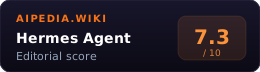
This page was produced by the aipedia.wiki editorial pipeline, an automated system that ingests vendor documentation, verifies product details against primary sources, and generates the editorial analysis shown. No individual human wrote this review. Scoring follows the four-dimension rubric at /about/scoring/ (Utility × Value × Moat × Longevity, unweighted average). Last verified 2026-06-12 against the Hermes Agent docs, GitHub repository, GitHub releases, and Nous Research.
FAQ
Is Hermes Agent free? Yes. MIT license, full feature set in the open-source release. The only cost is whatever model API the operator configures.
Which models work? Nous Portal, OpenRouter, NovitaAI, NVIDIA NIM, Xiaomi MiMo, z.ai/GLM, Kimi/Moonshot, MiniMax, Hugging Face, OpenAI, and custom endpoints are listed in the current GitHub README. Switching is a config/model selection change.
What makes it different from a Telegram bot? Persistent cross-session memory, auto-generated skills that the agent writes from experience, natural language cron scheduling, and a single process that bridges Telegram, Discord, Slack, WhatsApp, Signal, Email, and CLI.
Which sandbox backends ship? Six in the current docs/README: local, Docker, SSH, Daytona, Singularity, and Modal. Daytona and Modal are the serverless/persistent options that can hibernate when idle.
Who builds Hermes Agent? Nous Research, an AI research lab focused on open-weight models and agent architectures. Hermes Agent ships under the same org that publishes the Hermes model series.
Sources
- Hermes Agent official site: feature overview, platform list, setup docs
- Hermes Agent GitHub: MIT license, codebase, release notes
- Nous Research: lab background, Hermes model series
- Hermes Agent docs: sandbox backends, scheduling syntax
Related
- Category: AI Automation